My Advice to Banks on AI: David Cruddas of New Relic
David Cruddas, SVP and GM EMEA at New Relic, shares why banks must fix data quality before scaling AI - and why observability is the foundation of trustworthy AI.
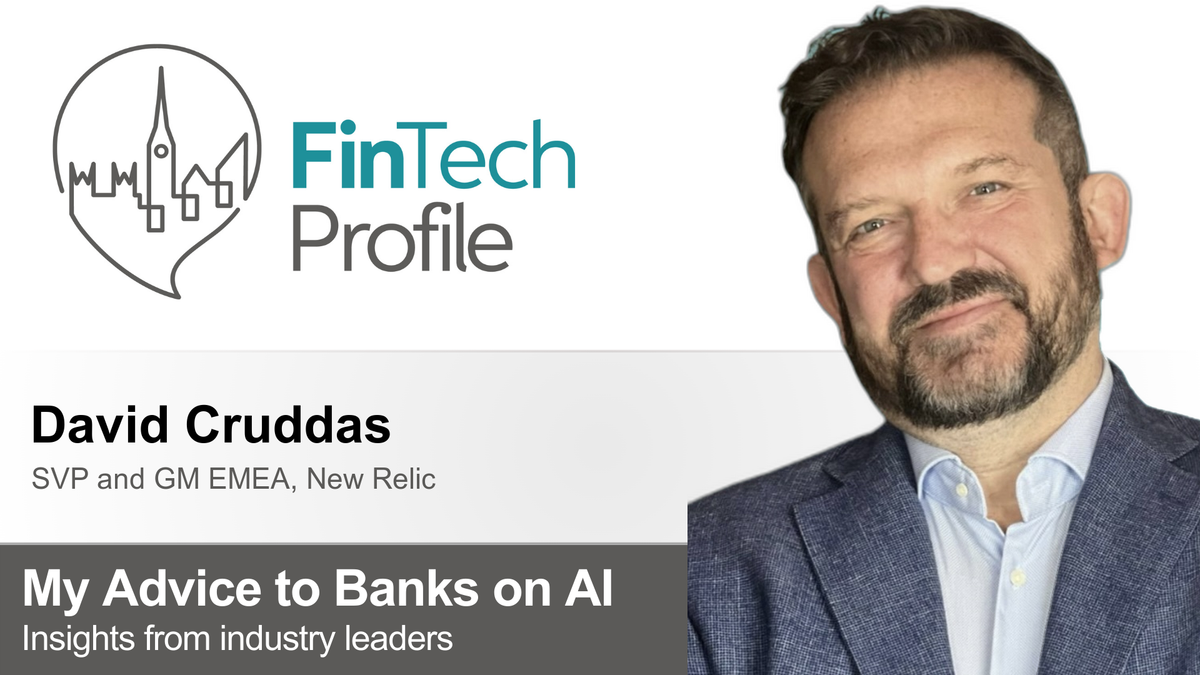
David Cruddas is Senior Vice President and General Manager of EMEA at New Relic, the intelligent observability company. He works closely with financial services customers to help them accelerate their success, improve reliability and deliver exceptional digital experiences - with a particular focus on maximising value and controlling costs through observability.
My questions are in bold - over to you David:
Can you give us an introduction to you and an overview of your organisation?
I am David Cruddas, SVP and General Manager of EMEA at New Relic, the intelligent observability company. New Relic helps organisations understand what's happening across their technology in real time, from applications and infrastructure to customer-facing digital services, enabling teams to identify, diagnose and resolve issues faster.
I am focused on driving continued growth and expanding intelligent observability across this region. I work closely with financial services customers to help them accelerate their success, improve reliability and deliver an exceptional digital experience. I am passionate about helping our customers maximize value and control costs through observability.
If you were advising a bank CEO today, what would you say is the single biggest mistake they're making with data and AI?
The single biggest mistake is treating AI as the antidote for chaotic, uncontextualized, legacy data. Too many executives assume that if they buy a powerful enough AI model, it will magically make sense of their fragmented data lakes. It won't.
When it comes to AI and data, context matters. If you apply AI to data without any context, you will get bad results and also pay a premium for them. We are seeing AI costs explode across the sector because the financial model of software is fundamentally changing. Banks are moving from fixed-cost software licenses to variable, consumption-based AI pricing. Under this pricing model, if you feed an AI model poor-quality, untrusted data, it will consume vast amounts of expensive compute power to process something that will end up being useless to you. The biggest mistake is failing to realise that before you can scale AI, you must first build a foundation of highly contextualised, observable data.
What's one AI or data capability banks should prioritise in the next 12-18 months, and why?
End-to-end data and AI observability. Right now, governance is often treated as an afterthought. That attitude doesn't work in the era of generative AI.
If you are using AI for credit assessments, fraud detection, or dynamic know your customer (KYC), your models are inherently complex. If your underlying data pipelines are also a black box, you will not have the answers to meet regulatory requirements. Observability is about continuously monitoring the health and quality of your data, services and underlying infrastructure in real-time. You cannot govern what you cannot observe. Prioritising observability ensures that anomalies are caught upstream, preserving accuracy and trust in the AI outputs downstream.
Where do you see banks overestimating AI, and where are they underestimating it?
According to New Relic data, financial services prioritise security, governance, risk, and compliance above all else when adopting observability. In contrast, AI adoption drives observability needs in most other sectors.
I think banks, together with other industries, are overestimating AI's ability to act autonomously and replace human expertise. Regulators are already warning that, for critical banking functions, there must always be a human in the loop to challenge and recover processes when automation fails. The idea of autonomous, plug-and-play AI is vastly overestimated and will not fly with regulators.
On the other hand, they are underestimating the amount of work that achieving good data quality requires. AI without deep, domain-specific context is just an impressive autocomplete engine. Banks underestimate the unglamorous, grueling work required to clean, label, and contextualise their data. Accuracy and trust are the most critical factors in financial services, and leaders routinely underestimate how quickly trust evaporates when an AI model acts on bad data.
What does "good" actually look like when AI and data are working well inside a bank?
"Good" looks like a system where trust is provable, and costs are aligned with actual business value. When AI and data are working well together, a business user can look at a predictive risk model or a customer insight and immediately trace it back to the data that informed it. There are no black boxes. We are actually seeing many financial services companies consolidate their tools in order to gain greater visibility and a single source of truth into their data. On average, organisations use 4.5 tools today, down from 5.1 the previous year. The infrastructure operates with proactive observability - meaning data anomalies are detected and quarantined before they can poison a model, not discovered during a post-mortem audit.
Furthermore, "good" means the bank has established IT systems which stand up on their own. Observability must move past just monitoring system health to actually measuring negative customer impact. When things are working well, AI is applied strategically to high-quality data to improve the customer experience, while highly automated, observable guardrails prevent run-away consumption costs.
What's the hardest AI or data decision bank executives are avoiding right now, and why?
The hardest decision is probably hitting "pause" on highly visible, hype-driven generative AI pilot projects to actually fund and fix their foundational data architecture.
Bank executives are under immense pressure from boards and shareholders to announce AI-driven transformations. But the reality is that 80% of their data is often siloed, unstructured, or simply untrustworthy. The average cost of high-impact outages is $1.8m per hour for financial services organisations. Having a strong data architecture goes a long way to protecting your bottom line. The decision executives are avoiding is telling the board: "We aren't ready for advanced AI yet because our data quality is poor, and if we scale this now, we scale our risk."
The honest truth is nobody gets promoted for fixing data quality or implementing a proper observability framework because it's considered unglamorous plumbing. But avoiding this decision is a ticking time bomb. Without a foundation built on data quality and proactive governance, scaling AI will simply result in faster, more expensive mistakes.
Many thanks to David for taking the time to share his insights with FinTech Profile. You can learn more about New Relic on their website.