My Advice to Banks on AI: Paul J. Loftus of Financial Institutions Group
Paul J. Loftus, CEO of Financial Institutions Group at Banyan Software, shares practical AI and data strategy advice for bank executives navigating digital transformation.
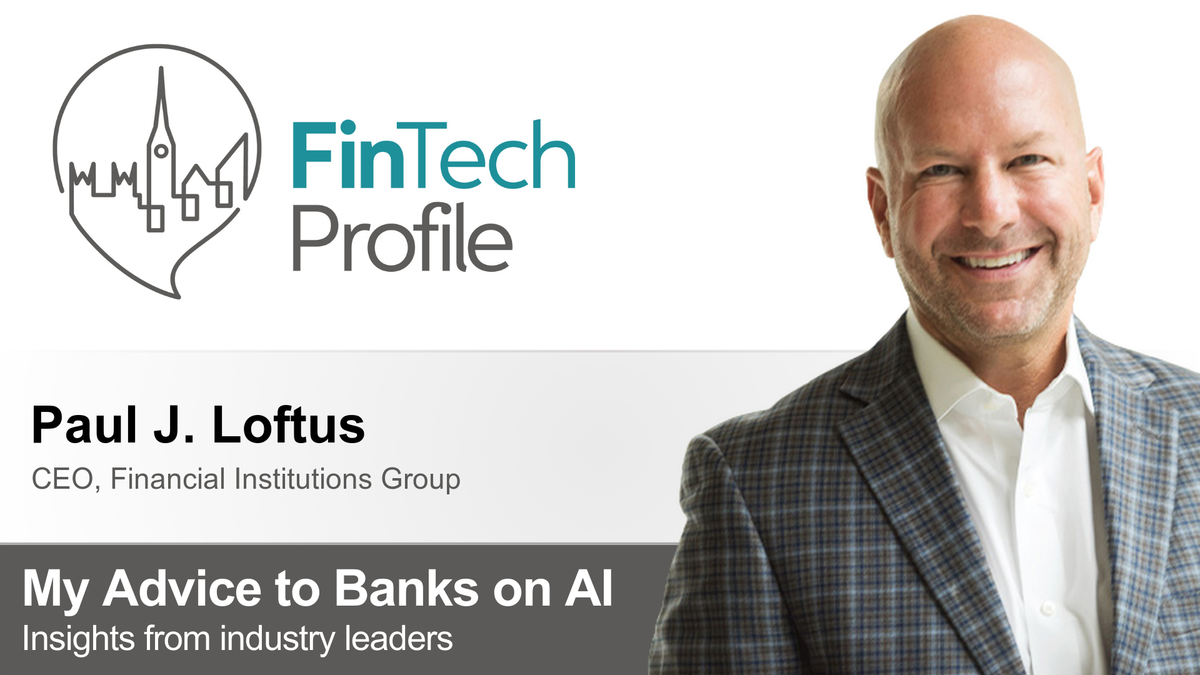
I spoke with Paul J. Loftus, CEO of Financial Institutions Group, a Banyan Software portfolio leading three fintech businesses serving community banks, credit unions and independent specialty lenders. With over 25 years of experience across enterprise software, data, and financial technology—including leadership roles at ADP and Wolters Kluwer—Paul brings a uniquely practical perspective on how banks should approach AI and data strategy.
Over to you Paul - my questions are in bold:
Can you give us an introduction to you and an overview of your organisation?
I serve as CEO of the Financial Institutions Group (FIG), where I lead a growing Banyan Software portfolio of fintech businesses focused on serving community banks, credit unions and independent specialty lenders. I originally joined as CEO of Loan Vision in 2023 following its acquisition by Banyan, bringing more than 25 years of experience across enterprise software, data, and financial technology—including leadership roles at ADP, Wolters Kluwer, and several high-growth SaaS businesses.
At Loan Vision, I was brought in to help scale what was already a strong mortgage accounting platform into a more structured, high-growth SaaS business. The company today serves ~300 Banks IMBs and Credit Unions and has become a critical system for loan-level accounting, financial management, and profitability insights in the mortgage industry.
As Banyan expanded its footprint in financial software, I was asked to lead the formation of FIG, bringing together Loan Vision with Automated Systems, Inc. (ASI), and shortly thereafter American Bank Systems (ABS), into a cohesive but independently operated portfolio. ASI is a core banking platform provider founded in 1981, with its flagship Insite Banking system acting as the system of record for community banks covering everything from teller operations to digital banking and back-office processing. ABS, which we acquired through ASI, adds a complementary layer focused on loan origination, document management, and compliance, with products like CoPilot and BankManager that help banks navigate complex regulatory requirements.
Collectively, FIG is built around a clear strategy: to create a long-term, independent alternative to large banking software conglomerates by offering mission-critical systems across accounting, core processing, and compliance while innovating daily and maintaining a deep focus on customer relationships and product durability. What makes this model possible is Banyan's commitment to acquiring and holding software businesses permanently, which gives FIG the runway to make multi-year investments in product, AI, and customer experience that competitors operating on a quarterly or fund-cycle basis cannot match.
If you were advising a bank CEO today, what would you say is the single biggest mistake they're making with data and AI?
The biggest mistake is trying to layer AI on top of fragmented, operationally misaligned data environments. I have always said technology does not solve for lack of discipline or instable / inconsistent foundational processes. AI is no different. I think it is critical to first assess your environment and your talent for adopting new technology. Not all FIs are created equal and many are at very different technological evolutionary journeys. Gaps in process or lack of discipline may only be magnified by layering tech or investing in AI. It is paramount that you evaluate your talent and processes before investing in technology/AI. Additionally, choose your innovation/tech partners carefully so that they act and become an extension of your financial institutions and have a mutual vested interest in your success criteria.
What's one AI or data capability banks should prioritise in the next 12–18 months, and why?
Banks should prioritise partnering with technology providers that are natively embedding AI and modern data capabilities into their platforms—so the bank doesn't have to build, manage, or chase innovation on its own. The reality is that technology has advanced to a point where settling for mediocre systems or service should no longer be acceptable. For too long, banks have tolerated outdated platforms and impersonal support from large software conglomerates because switching core systems was seen as too difficult or disruptive. That's no longer universally true. Advances in cloud infrastructure, integration layers, and data migration tooling have significantly lowered the barrier to change.
What matters now is choosing partners who are actually innovating both in their technology and in how they serve customers. The next generation of providers is leveraging AI not just to optimise their own cost structure, but to materially improve the customer experience. That means smarter workflows, faster implementations, more proactive support, and systems that continuously get better over time. Banks should expect white-glove service alongside modern technology. Being treated like a number in a vendor portfolio is no longer acceptable, your partner should know your institution, understand your business model, and actively help you improve it. The right AI capability, therefore, isn't just a feature, it's an embedded advantage delivered by your technology partner. They should be applying AI internally to become more efficient and externally to make your experience better, while also lowering your total cost of ownership over time. This is exactly the model we operate at FIG. As part of Banyan Software's portfolio of more than 100 vertical software businesses, we have access to a centralised AI engineering team and capital deployed specifically for AI initiatives across the portfolio. That means our customers benefit from AI investment at a scale a single vendor could never justify on its own.
Ultimately, banks should be asking a different question: not "how do we adopt AI?" but "who is the partner that is already doing this at a high level on our behalf?" The institutions that win will be the ones that make their innovation partners work for them…..not the other way around.
Where do you see banks overestimating AI, and where are they underestimating it?
Banks tend to overestimate AI in areas where data is least controlled, particularly customer-facing experiences. There's an assumption that AI can quickly transform personalisation or advisory, but those use cases depend heavily on clean, unified customer data and tight regulatory controls, which most institutions are still working towards. Where AI is underestimated is in the operational backbone, core processing, accounting, compliance workflows. These are exactly the areas our Banks, CUs & IMBs operate in, and they are rich with structured data and repeatable processes. Small improvements here, automating exception handling, improving reconciliation, streamlining reporting can drive meaningful efficiency gains and reduce risk at scale.
What does "good" actually look like when AI and data are working well inside a bank?
"Good" looks like consistency and trust across systems. A bank can run its core platform, generate financials, and produce compliance outputs without reconciling three different versions of the truth.
What's the hardest AI or data decision bank executives are avoiding right now, and why?
Banks should prioritise establishing a clear, modern system of record for their data—one that is unified, trustworthy, and designed to support AI from the ground up. The reality is that most institutions today are still operating with fragmented data spread across core providers, loan systems, spreadsheets, and a growing number of third-party tools. That fragmentation makes it incredibly difficult to apply AI in a way that is consistent, auditable, and trusted. Until that is addressed, most AI initiatives will continue to underdeliver. What's changing, and why this matters now, is that the barriers to fixing this are coming down. Advances in cloud technology, integration frameworks, and data architecture mean that banks are no longer locked into legacy environments in the way they once were. The long-held belief that core systems are too difficult to replace or modernise is increasingly outdated.
A practical example of where this is going can be seen in what we're building at Loan Vision is with LV-Luna. LV-Luna is an AI-powered internal and external agent that fundamentally changes how our customers interact with both their data and our platform. Instead of navigating systems, running reports, or requiring deep product expertise, users can simply ask questions, initiate workflows, and complete actions through a single, intelligent interface. In many ways, this mirrors the early evolution of the internet where users initially had to know exact destinations/ web addresses and then search engines transformed how information was accessed. LV-Luna becomes that "home base" for our customers: a centralised layer where insights are surfaced, questions are answered, and tasks are completed for them. This shift makes traditional software training far less relevant. You no longer need to be a system expert to extract value. The underlying complexity—loan-level accounting, financial reconciliation, operational workflows—is still there, but it's abstracted through an interface built for the everyday user. That's where AI becomes powerful: not as a feature, but as an access point to deep, domain-specific intelligence.
This is the direction we see across Financial Institutions Group more broadly. AI will increasingly sit on top of well-structured systems of record, acting as the primary way users interact with software. Our goal is to find our way into our customer's workstream, NOT the other way around! And LV-Luna is just one example. Across Banyan's portfolio of more than 100 software companies, we are seeing similar AI-native rebuilds across industries. The pattern is consistent: deeply embedded vertical software, paired with proprietary domain data and the operational support to ship real products, is where AI is creating the most durable advantage right now.
Thank you Paul! You can connect with Paul on his LinkedIn Profile and find out more about the company at www.loanvision.com.