My Advice to Banks on AI: Tamsin Crossland of Icon Solutions
Tamsin Crossland, Principal AI Architect at Icon Solutions, shares practical advice for bank executives on implementing AI strategy, data foundations, and enterprise transformation.
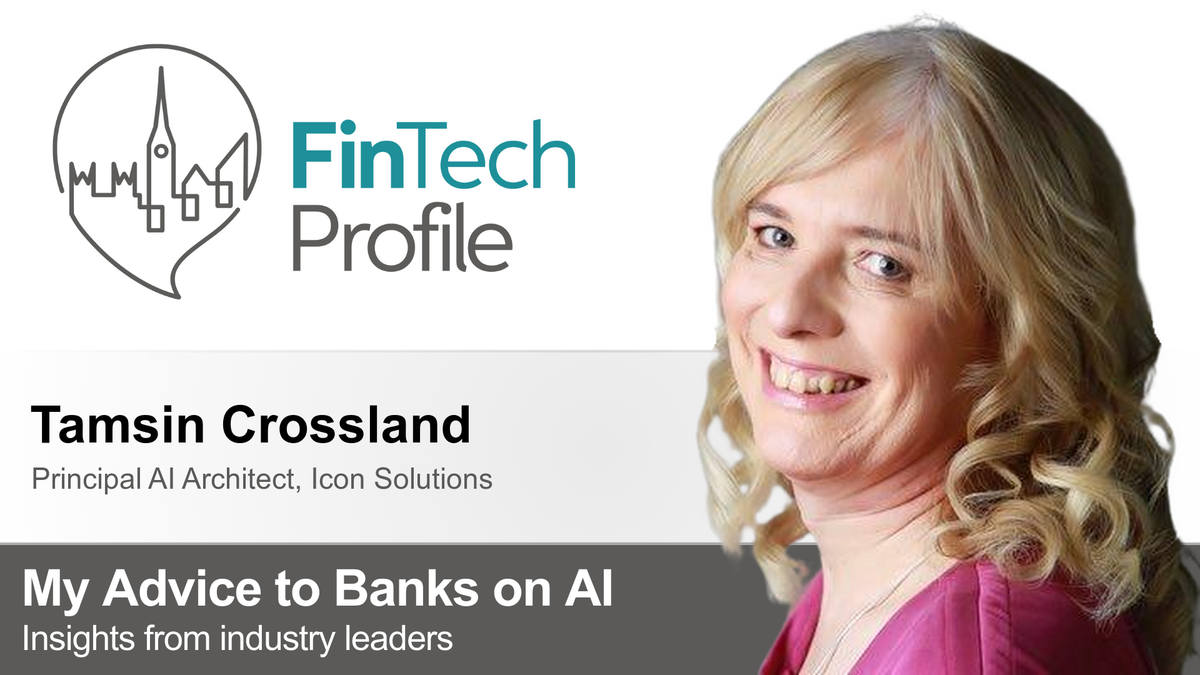
I spoke with Tamsin Crossland, Principal AI Architect at Icon Solutions, about what bank executives are getting wrong with AI and data. With experience dating back to the late 1980s in artificial intelligence and decades working with financial institutions, Tamsin shares her practical advice on moving beyond AI experimentation to enterprise-scale implementation.
Over to you Tamsin - my questions are in bold:
Can you give us an introduction to you and an overview of your organisation?
I first began working with artificial intelligence in the late 1980s, when the field was centred on expert systems and early knowledge-based AI. At the time, the technology was largely academic and experimental, but it sparked a long-standing interest in how intelligent systems could support complex decision-making.
In the decades since, I have built a career in financial services, working closely with banks on technology, data and transformation initiatives. Over the last eight years, as advances in data, computing power and machine learning have made AI commercially viable at scale, I have been focused on helping financial institutions turn AI from experimentation into practical, enterprise-grade capability.
Alongside my industry work, I regularly speak at industry conferences on AI, data and financial services innovation, and I am a co-author of The AI Book, which explores how artificial intelligence is reshaping the financial sector.
Today, I lead Icon Solutions' AI and Data practice, combining decades of financial services experience with a deep understanding of AI to help banks design and implement responsible, enterprise-scale AI systems that deliver meaningful business value.
Icon Solutions is a specialist technology consultancy focused on helping financial institutions modernise their platforms, data and operating models. The company works primarily with banks and payment providers, combining deep domain expertise in payments, core banking and financial crime with strong capabilities in architecture, engineering and large-scale technology transformation. Icon supports clients globally, helping them deliver complex, mission-critical systems safely and at enterprise scale.
In recent years, Icon has expanded its focus to include AI and advanced data capabilities, recognising that financial institutions must adopt artificial intelligence in a controlled, enterprise-grade way rather than through isolated experiments. Its AI offering is built around the principle that successful AI requires strategy, architecture, engineering and governance working together across the full lifecycle.
Icon helps banks implement AI safely and responsibly through several key capabilities:
AI consultancy and strategy. Icon advises financial institutions on how to develop practical AI strategies and roadmaps aligned to business objectives. This includes assessing organisational readiness, identifying high-value use cases, and ensuring alignment with regulatory frameworks such as emerging AI governance standards.
Enterprise AI architecture and design. A core strength of Icon is designing enterprise-grade AI architectures. This includes integrating modern AI technologies, such as generative AI, machine learning and data platforms, into secure, scalable banking environments. The firm combines its long-standing architecture expertise with modern approaches such as cloud-native, event-driven and MLOps-enabled architectures to ensure AI solutions can operate reliably in production.
Data architecture and foundations for AI. Icon places particular emphasis on the importance of strong data foundations. Its teams help banks design and implement governed, high-quality data architectures that enable AI systems to access reliable information while maintaining regulatory compliance and operational integrity.
AI engineering and solution delivery. Beyond strategy and design, Icon delivers production-ready AI systems, taking solutions from proof-of-concept through to enterprise deployment. This includes model development, integration with banking platforms, and operational monitoring to ensure performance, accuracy and reliability.
Responsible AI and governance. Given the regulatory and ethical requirements facing banks, Icon also supports the design of governance frameworks covering the full AI lifecycle. This includes model monitoring, explainability, human oversight and compliance controls to ensure AI systems remain transparent, auditable and aligned with regulatory expectations.
To accelerate adoption, Icon has developed the SAIFE AI framework, which ensures AI initiatives are strategically aligned with business goals, architected for scalability and security, assessed for operational and regulatory impact, financially viable, and enterprise-ready for production deployment.
The firm's approach is reinforced by deep industry knowledge. Icon's expertise in payments, banking platforms and financial crime systems allows it to embed AI into mission-critical financial infrastructure rather than treating it as a standalone technology layer.
A recent engagement with a global Tier-1 bank illustrates this approach. Icon helped take a generative AI compliance advisory solution from proof of concept into production, enabling staff to receive AI-assisted responses to regulatory and policy queries. The system incorporated safeguards such as human-in-the-loop review, confidence scoring and continuous model monitoring, improving response accuracy while reducing turnaround time by 50%.
Overall, Icon Solutions positions itself as a partner that helps banks move beyond experimentation and deploy AI safely, responsibly and at scale, combining its deep financial services experience with practical expertise in architecture, data and AI engineering.
If you were advising a bank CEO today, what would you say is the single biggest mistake they're making with data and AI?
If I were advising a bank CEO today, I would say the single biggest mistake being made with data and AI is simple: too many organisations are starting with the technology rather than the business problem.
Over the past two years, the financial services industry has been flooded with promises about artificial intelligence. Technology vendors are racing to position their platforms as the solution to every challenge, from customer service to compliance to fraud detection. The result is a wave of AI experimentation across banks: labs, pilots and proof-of-concepts everywhere.
Yet experimentation is not transformation.
The mistake many banks are making is allowing technology hype to dictate their agenda. Instead of asking, "What problems do we need to solve?" organisations are asking, "How can we use generative AI?" That subtle shift in thinking can lead to enormous, wasted effort.
When AI initiatives start with the technology, they tend to produce impressive demonstrations but very little real impact. Teams build prototypes that look exciting but are disconnected from operational systems, regulatory constraints, or the realities of how the bank actually works. The result is what many executives privately describe as "AI theatre": clever ideas that never scale beyond the pilot stage.
Banks do not need more proofs of concept. They need solutions that work in production.
The way to achieve that is to reverse the process. AI must start with clear business requirements. What decision needs to be improved? What cost needs to be reduced? What customer experience needs to be transformed? What risk needs to be managed more effectively?
When those questions come first, AI becomes a tool rather than a destination.
Take compliance operations as an example. A bank might have thousands of regulatory queries being handled manually by experts. That is a clearly defined operational problem: slow turnaround times and high costs for specialised staff. In that context, AI can be applied in a targeted way; augmenting experts with intelligent search, summarisation and response generation, while keeping human oversight in place. The technology is serving the business requirement, not the other way around.
The same principle applies across the enterprise. Fraud detection, payments monitoring, credit risk assessment, operational efficiency; these are all areas where banks already understand the business challenges. AI can help, but only if it is integrated into processes, data flows and governance frameworks that already exist.
Another reason starting with business requirements matters is scale. Large banks are complex, regulated organisations with deeply embedded systems and strict controls around risk and data usage. A solution that looks impressive in a lab environment may fail completely when confronted with real-world constraints such as regulatory oversight, auditability, data lineage and operational resilience.
That is why the most successful AI initiatives in banking are not the most technically sophisticated ones. They are the ones designed from the beginning to operate within the bank's real environment.
There is also a strategic risk in following vendor hype too closely. Technology vendors understandably promote their own platforms and capabilities. Yet banks that allow vendors to define their AI strategy can quickly find themselves locked into specific technologies that may not suit their long-term needs.
AI strategies should be vendor-neutral and problem-driven. Technology choices should support the strategy, not define it.
None of this means banks should be cautious about AI. On the contrary, AI will reshape financial services over the next decade in ways we are only beginning to understand. Institutions that fail to embrace it will fall behind.
But success will not come from chasing every new technological breakthrough. It will come from applying AI with discipline, clarity and purpose.
In the end, the biggest competitive advantage in AI will not be who has the most advanced algorithms. It will be who understands their business problems best, and uses technology to solve them.
For bank CEOs, the message is straightforward: do not ask your teams how they can use AI. Ask them what problems they need to solve. The right uses of AI will follow.
What's one AI or data capability banks should prioritise in the next 12–18 months, and why?
One capability banks should prioritise over the next 12–18 months is Graph AI, technology that focuses on understanding the relationships between data.
Over the past couple of years, many banks have implemented retrieval-augmented generation (RAG) to make large language models safer and more useful by grounding them in internal documents. They are also beginning to experiment with agentic AI, where systems can take more autonomous actions across workflows. These developments are important, but both approaches still largely rely on how well a bank understands and structures its underlying data.
That's where Graph AI becomes critical. Banks hold vast amounts of interconnected information: customers, accounts, transactions, merchants, devices and networks. Graph technology models these connections explicitly, allowing AI systems to detect patterns and relationships that traditional data approaches often miss.
The impact can be significant. Graph AI can dramatically improve fraud detection, financial crime prevention, risk analysis and customer insights because many of these problems are fundamentally about networks of behaviour rather than isolated data points. For example, identifying hidden connections between accounts or unusual transaction patterns becomes much easier when those relationships are mapped and analysed.
Importantly, Graph AI also strengthens the foundations for other AI technologies. RAG systems become more accurate when knowledge is structured as connected data rather than scattered documents, and agentic AI can make better decisions when it understands how entities relate to one another across the organisation.
In short, while banks have been focused on generative AI interfaces, the next competitive advantage may come from improving how AI understands relationships within data. Graph AI provides that capability, turning fragmented information into a connected view of the financial ecosystem.
Where do you see banks overestimating AI, and where are they underestimating it?
Banks are currently both overestimating and underestimating AI in different ways.
On one hand, many banks overestimate what AI can deliver in the short term. There has been a great deal of excitement driven by technology vendors and the rapid rise of generative AI, which can make it seem as though powerful AI capabilities can be dropped into an organisation and quickly transform operations. In reality, the effectiveness of AI depends heavily on the quality, governance and accessibility of the underlying data. Many banks still operate with fragmented legacy systems and inconsistent data architectures. Without strong data foundations and enterprise governance, AI initiatives often remain confined to proofs of concept rather than delivering sustainable value.
Banks also sometimes focus on the technology itself rather than the long-term business outcomes they are trying to achieve. Deploying a chatbot or experimenting with generative AI tools may demonstrate innovation, but unless these initiatives are aligned with strategic goals, such as improving customer retention, reducing operational risk, or strengthening fraud prevention, the impact tends to be limited.
At the same time, banks are underestimating AI's true long-term potential. When AI is approached as part of a broader transformation, supported by modern data architecture, clear governance, and a technology vendor-neutral strategy, it has the potential to reshape how banks operate. AI can fundamentally improve how institutions understand customer behaviour, detect financial crime, automate complex processes and manage risk across the enterprise.
The key difference is perspective. If AI is treated as a short-term technology deployment, its benefits are often overstated. But when it is built on strong data foundations and aligned with long-term business strategy, its ability to transform banking, improving efficiency, resilience and customer experience, may actually be significantly underestimated.
What does "good" actually look like when AI and data are working well inside a bank?
When AI and data are working well inside a bank, "good" doesn't just mean sophisticated models or faster automation. It means the technology is trusted, responsible, and aligned with real business outcomes.
First, customers experience better, fairer services. AI helps banks anticipate needs, detect fraud earlier, and resolve issues faster, while ensuring decisions, such as credit approvals or risk assessments, are transparent and explainable. Customers should feel that the bank understands them and treats them fairly, not that opaque algorithms are making arbitrary decisions.
Second, AI is governed responsibly. Strong data governance, ethical frameworks, and model oversight ensure that systems are auditable, unbiased, and compliant with regulation. "Good" AI in banking means models are monitored continuously, decisions can be explained to regulators and customers, and there are clear accountability structures when things go wrong.
Third, AI operates at enterprise scale rather than as isolated experiments. Successful banks embed AI into core operations, from risk and compliance to customer service, supported by robust data infrastructure, high-quality data management, and consistent standards across the organisation. This allows insights and capabilities to be reused rather than rebuilt in silos.
Finally, AI clearly supports long-term business objectives. When it's working well, it strengthens customer relationships by enabling more personalised services, reducing friction in everyday banking, and building trust over time. In other words, the real measure of "good" AI isn't the sophistication of the technology; it's whether it helps the bank deliver better outcomes for customers, regulators, and the business over the long term.
What's the hardest AI or data decision bank executives are avoiding right now, and why?
One of the hardest decisions many bank executives are avoiding right now is taking ownership of their long-term AI strategy rather than outsourcing it to technology vendors.
Under pressure to demonstrate quick progress, many banks are turning to large technology providers who offer ready-made AI platforms, tools, or generative AI solutions. These can deliver visible results quickly, such as chatbots, document assistants, or internal productivity tools, which helps demonstrate momentum to boards and shareholders. Yet vendors are naturally focused on selling their products, which means the conversation often centres on technology features rather than the bank's long-term business strategy.
The more difficult decision for executives is stepping back and asking: what role should AI actually play in the future of the bank? That requires defining long-term goals, such as improving customer retention, strengthening financial crime detection, or transforming operational efficiency, and then designing data architecture, governance, and AI capabilities around those outcomes.
Taking this approach also means adopting a vendor-neutral strategy, building strong internal data foundations, and ensuring the bank retains control over how AI systems are designed, governed and integrated across the enterprise. That takes longer and requires deeper organisational change, which is why it is often postponed.
So the difficult decision isn't whether to adopt AI; banks have already made that choice. The real challenge is whether to treat AI as a series of quick vendor-led deployments, or as a strategic capability that is deliberately built to support the bank's long-term business model. Many institutions are currently choosing the easier path, but the competitive advantage will likely go to those willing to make the harder, more strategic decision.
Thank you Tamsin! You can connect with Tamsin on her LinkedIn Profile and find out more about the company at iconsolutions.com.