Chiara Gelmini, FS Industry Solutions Director, Pegasystems
Chiara Gelmini discusses transforming compliance from cost centre to competitive advantage, the rise of predictable AI in banking, and why financial crime prevention is becoming existential for FSIs.
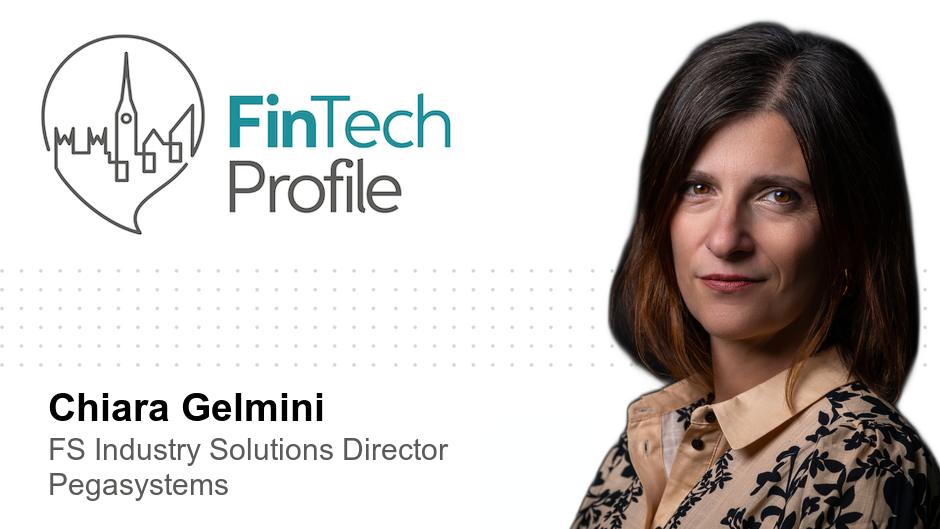
Today we're delighted to speak with Chiara Gelmini, FS Industry Solutions Director at Pegasystems. With nearly two decades of experience spanning compliance, KYC, AML, and financial crime investigation, Chiara brings a unique perspective on how banks can turn regulatory complexity into competitive advantage. From her unconventional start in sociology to shaping enterprise AI strategy for global financial institutions, this conversation explores the gap between transformation ambition and execution - and how to close it.
My questions are in bold - over to you Chiara:
Who are you and what's your background?
I came into technology for financial services a bit unconventionally. I studied sociology at university, which I know sounds very far from banking, but looking back at it, that has fundamentally defined how I see transformation. Sociology is about systems, relationships, and how groups of people create shared meaning and change together. Turns out banking is exactly that: a complex system where changes in underlying technology and process only work if you get the people and culture aligned first.
I entered the FS industry as a compliance and KYC officer at an international wealth management firm, which taught me first hand where the real friction points live in financial services. For nearly two decades since then, I've worked across the full spectrum of FSI transformation across the most complicated domains like due diligence, anti-money laundering and fincrime investigations - from deep product and strategy work on client onboarding platforms, to leading global consulting teams, to now shaping how a global enterprise software platform like Pega serves the banking sector. I've been working across different geographies and bank types: wealth managers and private banks, retail, commercial and institutional banks, tier-1 universal banks - each with their own complexity around managing client relationships, regulatory risk, and operational efficiency.
My biggest lesson learned from all of it is this? Banks know they need to transform, but the gap between knowing and doing is where most firms get stuck. That gap often isn't really in technology - it's about understanding technology and aligning people and objectives. That's what drew me to Pega. I'm here because I see an opportunity to help financial institutions close that gap, to turn the chaos of regulatory change, technological innovation (including the latest agentic-AI revolution), and market disruption into a coherent strategy that their executives, technology teams, and operations leaders can confidently execute together.
I was recognised as one of the Top 25 Women Leaders in FinTech Europe a few years back, which was humbling. But honestly, the recognition that matters most to me comes from the clients and partners who know they can call me when they're wrestling with a hard strategic decision or need a trusted perspective on what's really possible in their market. That trust is everything.
What is your job title and what are your general responsibilities?
As an FS Industry Solutions Director at Pega, I sit at the intersection of where client needs, market dynamics, and our platform capabilities come together. What's my day-by day looking like?
First, advisory. I engage executives and senior functions at global and regional financial businesses - across risk, compliance, operations and IT areas - to understand their transformation agendas and how they can leverage technology and Pega's solutions to achieve their goals. Most of them are faced with the same challenges: how to modernise client lifecycle management (CLM) without disrupting the relationships that drive their business; how to strengthen KYC and AML processes without turning customer onboarding into a three-week nightmare and while complying with everchanging regulations and laws; how to assess and manage financial crime at the velocity and scale that modern risk demands. If I had to describe it in one sentence I'd say that my job is to turn complex business challenges into actionable transformation opportunities with a clear vision of how technology can deliver measurable outcomes.
Second, solution strategy. I help shape how Pega positions and evolves our solutions across CLM, KYC, AML, and financial crime investigation management. That means bridging product, sales, marketing, and our analyst relations to ensure we're building solutions that solve real problems in the real world, not just features that sound good in a pitch deck but nobody really needs. I spend a lot of time saying things like "here's why a tier-1 bank's compliance team actually needs this" or "here's where the current approach breaks down when you're managing sanctions screening across 60 jurisdictions."
Third, thought leadership and partnerships. I'm a frequent speaker at industry conferences and Pega events - PegaWorld, ACAMS, EY's FinCrime Conferences, risk transformation execs dinners. I chair and facilitate our Pega Customer Risk and Due Diligence community forum. I write and publish on financial crime, AI in compliance, CLM modernisation. I'm a firm believer that the financial services industry needs better conversations and more open exchange about how to actually transform, not just how to implement vendor software. When I speak, I'm trying to help the room think more clearly about what's genuinely hard and what's just complex.
It's exciting work, and it's exactly where I want to be. I get to share all I've learned across 20 years of transformations, and I get to help shape the future of how banks manage their most critical operations, ultimately contributing to a better society overall. That's the real purpose of Compliance and Risk Management. It's not about ticking boxes or making regulators happy. It's about making our world safer.
If you had a magic wand, what one thing would you change in the banking and/or FinTech sector?
Well, many things come to mind. Though, I think the one aspect I'd change above all would be how financial institutions think about compliance and risk as limitations versus advantages and catalysts for true transformation. I'd move compliance from a back-office cost centre into the executive strategy conversation where it belongs.
Right now, most banks treat regulatory requirements as "things we have to do" that live in the compliance department, run by compliance people, measured by compliance metrics. A self-contained, convoluted mini-universe. The business functions see it as overhead. Regulators demand all checkboxes to be ticked. What we are left with is that compliance systems are built to pass audits, not to create meaningful value.
What I've seen separating winning FSIs from laggards is that they've actually inverted this. They've made compliance and risk management fundamental to how they compete. Think about it differently: if your KYC process is genuinely robust and fast, you can onboard customers in days instead of weeks while actually knowing who they are. If your sanctions screening is intelligent, not just rule-based, you catch real threats instead of generating false positives that waste analyst time. If your financial crime investigations system uses AI to find patterns instead of just flagging transactional rules, you actually prevent harm instead of reacting to it. If your CLM process is automated and transparent, you build trust with clients through clarity, not bureaucracy.
It becomes competitive advantage.
This is precisely why the industry's relationship with AI matters so much right now, and why I believe so strongly in what we call Predictable AI at Pega: the idea that in a regulated environment, AI's value isn't only measured by how clever it looks in a demo, but more importantly by whether every decision it makes can be explained, audited, and trusted by a regulator, a customer, and a risk committee at the same time. An AI that can't be governed isn't an asset to a bank - it's a new category of risk hiding behind a new category of hype. Winning institutions won't be the ones who dump the most AI and Agents on their workforce; they'll be the ones who deploy AI they can stand behind, transparently, every single time - where AI Agents are intelligently orchestrated within the explainable boundaries of workflow and deterministic rules, so they are predictable in the outcomes (and costs!).
That's also the thinking behind moving away from KYC and due diligence being a point-in-time exercise - onboard once, review periodically, hope nothing material changes in between - we should redefine them as a continuous, all-party, risk-intelligent tech capability: knowing the customer from first interaction to last, reserving enhanced due diligence for where risk is genuinely proven, and letting everything else flow straight through.
It's the compliance-as-catalyst philosophy made real in software - governed AI doing the heavy lifting continuously in the background, so the moments that actually need a human are the moments that matter.
Banks who flip the 'compliance & tech' narrative in this way are not just safer and more compliant. They're faster to market, they attract better customers, they retain talent better. They're genuinely better businesses.
Finally, let's talk predictions. What trends do you think are going to define the next few years in the FinTech sector?
I see three overlapping forces are reshaping financial services right now, and they're all creating both tremendous disruption and tremendous opportunity.
Number one is AI. AI is becoming the operating system for decisioning, but governance is the real bottleneck. Everyone's talking about generative AI and agentic systems. Banks are experimenting. But here's the hard truth: you cannot have an autonomous client onboarding decision, an autonomous sanctions screening decision, or an autonomous KYC approval. Regulators - quite rightly - want to know exactly why a decision was made. That means explainability, auditability, and human judgement in the loop. The winners in the next three years won't be the banks that deploy the flashiest AI. They'll be the ones who can weave AI into their decisioning architecture in ways that make their risk officers smarter and faster, while keeping the explainability and governance regulators (and quite frankly their own risk management and audit functions) demand. That's harder than it sounds, and most banks are still figuring out how to do it.
Second: Regulatory velocity isn't slowing down. And didn't for the past 10 to 5 years. Compliance tech infrastructure is becoming a speed advantage. We've all felt this - new regulations drop, and banks have 12 months to implement them. AML/CFT rules are getting more sophisticated. Data privacy is evolving. Sanctions regimes shift based on geopolitical events. The banks that will thrive are the ones with compliance infrastructure flexible enough to adapt quickly. Monolithic systems built in 2010? They're a liability now. FSIs need orchestrated workflows, intelligent case management, agents augmenting human productivity and judgement, the ability to rapidly model and deploy new rules without a six-month project. Compliance is increasingly not just about risk mitigation, but about agility.
Last but not least: Financial crime is getting more sophisticated, keeps morphing as criminal make use themselves of the latest technologies and innovations, and so must risk management. We're seeing money laundering techniques that are increasingly hard to catch with traditional transaction monitoring rules. Beneficial ownership structures are nested and complex. Sanctions evasion uses legitimate financial channels in ways that don't look like evasion at first. The firms winning this battle are using network analysis, behavioural analytics, AI pattern recognition and agentic automation across multiple data sources and time horizons. They're linking financial crime investigation, sanctions, AML, and customer risk management as one integrated system instead of silos. The banks that can see the full picture across all these domains will catch threats that fragmented systems miss.
The bottom line across all of these three themes is that transformation is no longer optional, not even strategic - but rather existential. The banks that treat compliance, AML, KYC, and financial crime prevention as opportunities to rethink they way the industry used to manage them, build better, more agile, more trustworthy operations will win. The ones trapped in the old logic of seeing them as mere costs to minimise will eventually lose.
Many thanks to Chiara Gelmini for taking the time to share her insights with FinTech Profile. You can learn more about Pegasystems and their approach to AI-powered enterprise transformation at their website.