Dr. Marlene Wolfgruber, Product Marketing Lead for AI, ABBYY
Dr. Marlene Wolfgruber discusses how ABBYY is helping financial institutions move beyond AI hype to build purposeful, trustworthy automation grounded in Document AI and process intelligence.
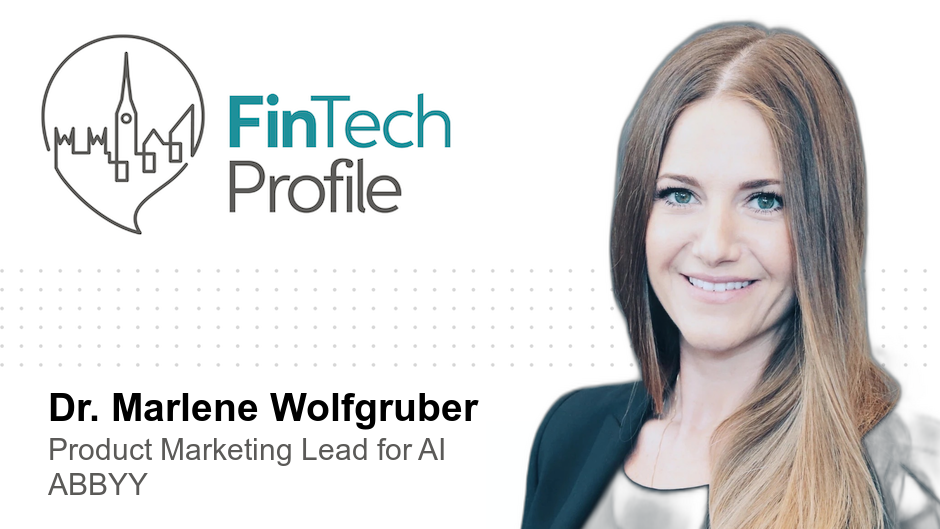
Today we're delighted to speak with Dr. Marlene Wolfgruber, Product Marketing Lead for AI at ABBYY. With over a decade in intelligent automation and a background in computational linguistics, Marlene brings a refreshingly grounded perspective on AI adoption in financial services - one that prioritises solving real business problems over chasing hype. In this interview, she shares how ABBYY is helping enterprises turn their documents and data into intelligence, why context engineering matters more than model size, and what trends will define the next few years in fintech.
My questions are in bold - over to you Marlene:
Who are you and what's your background?
I'm Dr. Marlene Wolfgruber, Product Marketing Lead for AI at ABBYY, a computational linguist by training, and a podcast host on the side. I was born and raised in Munich, and it's still home for me and my family.
My path into AI started, oddly enough, with a hotel review. While writing my thesis on sentiment analysis at Ludwig Maximilian University of Munich, I noticed something a generic model would never catch. Whenever a review mentioned "the carpets," it was never a compliment. It was shorthand for a dingy, poorly kept room. A general-purpose sentiment model would read that sentence as neutral, maybe even positive - no obvious negative words - and completely miss the point.
That one detail taught me the lesson that's shaped my whole career: language only means something in context, and AI is only as good as its understanding of the context it is working in.
What is your job title and what are your general responsibilities?
I'm the Product Marketing Lead for AI at ABBYY, with more than a decade in product management and product marketing across intelligent automation. My job, in short, is to help organisations understand and adopt AI in a way that actually solves their problems - and not only AI for AI's sake.
Can you give us an overview of your business?
ABBYY started with a simple idea more than three decades ago: unlock the information trapped inside documents and make it useful. That idea hasn't changed. What has changed is how far the technology can now take it.
We're headquartered in Austin, Texas, with offices in 13 countries, and more than 10,000 enterprises - including a large share of the Fortune 500 - run on our technology. What's guided us the whole way is a simple principle: never adopt AI for its own sake, only where it genuinely solves a customer's problem. That's why we moved from OCR to Document AI in the first place - capturing text off a page was never the point. Understanding it was.
Erste Digital, part of the Erste Group financial services family, is a good example of that principle in practice. They use our Document AI across invoice processing, petty cash handling, guarantee processing, energy certificates, and lease documents, built with citizen developers in mind. The technology fits how their teams work, not the other way around.
Our flagship platform, Vantage, is where this comes together: a low-code IDP solution that captures and extracts data from structured, semi-structured, and unstructured documents, with pre-trained models delivering 90%+ accuracy out of the box, and native integration into RPA, BPM, ERP, and LLM platforms.
With Vantage 3.0, we took the next logical step of directing LLM integration. Not because generative AI is trendy, but because it has a real weakness that purpose-built AI can fix - reliability. Vantage feeds LLMs clean, verified, structured data instead of raw documents, which is what makes generative AI trustworthy and explainable in a regulated environment. It's built on a modernised stack, with a new analytics dashboard, compliance and redaction tools, and an expanded model library. FlexiCapture complements it for teams with more specialised capture needs.
The throughline across everything we build is combine the right technologies - Document AI, Process AI, generative AI - around a real problem, rather than bolting on whatever's newest. IDP is already deeply embedded in how our customers operate. Our job now is making sure next-gen AI strengthens that foundation instead of replacing it.
Tell us how you are funded?
As a privately held company backed by Marlin Equity Partners, our largest investor, we have the flexibility to focus on long-term innovation. We continually reinvest in our technology and capabilities to help our customers stay ahead as the market rapidly evolves.
Our partnership brought together two organisations with a shared focus of helping businesses use technology to work smarter and drive better outcomes.
With Marlin becoming ABBYY's largest shareholder, the investment provided strong support for our continued growth and global expansion. It also reflected the confidence in ABBYY's technology, our strong customer relationships, and the opportunity ahead in intelligent automation.
Marlin's decision to partner with ABBYY was driven by the strength of our solutions, our proven track record, and the growing need for businesses to automate processes in a smarter way. Together, we're focused on continuing to innovate, deliver value for our customers, and help organisations navigate the future of work.
What's the origin story? What problems does the company solve?
Financial services organisations face three persistent challenges: improving operational efficiency, reducing costs, and delivering seamless customer experiences - all while meeting increasingly complex regulatory requirements.
ABBYY addresses these challenges by enabling organisations to automatically read, understand, and extract data from documents such as loan applications, invoices, bank statements, and identity documents, then route that information directly into business systems. This reduces manual processing, accelerates decision-making, improves accuracy, and frees employees to focus on higher-value work.
ABBYY works closely with customers to solve real business challenges. One example is our partnership with financial services firm FinTrU. To help global banks manage complex regulatory processes, FinTrU developed TrU Label, a platform that automates document-intensive workflows using ABBYY's AI technology. The platform is used for high-complexity tasks such as Know Your Customer (KYC) compliance and credit risk assessments - enabling FinTrU to handle large volumes of financial documents accurately and efficiently while meeting the strict regulatory and compliance standards expected by its banking clients.
Beyond automation, ABBYY has made responsible AI a strategic priority. We were among the first companies to publish an AI Risk Management Policy aligned with the EU AI Act, reflecting our commitment to transparency, accountability, and trustworthy AI. We're also working with ForHumanity to develop a Model Risk Management (MRM) solution that helps organisations monitor AI-related risk, strengthen governance, and confidently adopt AI at scale.
Who are your target customers? What's your revenue model?
ABBYY's customers are large enterprises across countries and industries where document-heavy processes and complex workflows are critical to the business. These include financial services, transportation and logistics, manufacturing, insurance, healthcare, government and other regulated sectors.
In the financial sector, for example, ABBYY works with Banque Populaire de l'Ouest, part of a large French banking group, to improve some of its most document-intensive processes. The bank was handling thousands of cases every year, with information coming in through different channels, including paper and email. This made manual processing slow and made it harder for teams to quickly find and use the information they needed. ABBYY helped the bank modernise workflows in areas such as credit applications and inheritance cases, making processes faster and more efficient for employees and customers.
Another example is a Fortune 100 financial services organisation that wanted to better understand the efficiency of its processes across hundreds of internal systems and a huge volume of transactions. Using ABBYY Process Intelligence, its analysts were able to quickly identify where improvements could have the biggest impact and build stronger business cases for change.
The feedback we get from customers is that ABBYY helps them move from assumptions to clear, data-driven decisions. As one customer's Director of Business Planning put it, ABBYY process mining stands out for how quickly it turns questions into quantitative results strong enough to secure funding for the right business cases.
If you had a magic wand, what one thing would you change in the banking and/or FinTech sector?
I'd make AI adoption more purposeful - genuinely focused on solving a real business problem, rather than chasing the excitement around generative AI for its own sake.
That excitement is real, but a one-size-fits-all approach rarely works in a highly regulated industry like financial services. Our own research backs this up, in ABBYY's State of Intelligent Automation: GenAI Confessions survey, 32% of UK leaders said their staff simply didn't have the skills to deploy generative AI, 30% found training the models harder than expected, and 25% struggled with integration.
The future isn't about using AI in a way everyone else is. Financial institutions need AI built around their specific processes, data, and regulatory reality - not a generic tool wearing an AI label.
The biggest opportunity is bringing different AI capabilities together: understanding documents, extracting insight from data, analysing processes, and automating the workflow around all of it. When those pieces work together, organisations make faster, better decisions while actually reducing risk. We're already seeing this play out - UK leaders in our survey said process intelligence (42%), Document AI (38%), and retrieval-augmented generation (25%) all helped them get past the rough edges of generative AI adoption, delivering more consistent, more accurate, and more cost-efficient results.
This matters most in fraud prevention, compliance, and customer onboarding. As financial crime gets more sophisticated, banks can't rely on manual review and reactive processes anymore. AI has to help them catch risk earlier and give teams the confidence to act on what they find.
Our partnership with IBM watsonx.ai Orchestrate is a good example of this. Combining Document AI, Process AI, and workflow automation to modernise KYC for regulated financial and insurance organisations, turning the entire process, from document intake to compliance monitoring, into something transparent and scalable rather than a black box.
If I had that magic wand, I'd help every financial organisation move past AI experimentation and into confident, purpose-built action - for themselves, their employees, and their customers.
What is your message for the larger players in the Financial Services marketplace?
Don't underestimate the value sitting quietly in your documents and data.
Financial institutions handle enormous volumes of complex information every single day: customer applications, contracts, claims, compliance filings. Often they vary across different formats, languages, and systems. That fragmentation is exactly why so much of that value stays locked up.
This is where Intelligent Document Processing earns its keep. Modern IDP isn't about digitising paper, it is about using AI to understand, extract, and act on information, so organisations can automate processes, improve accuracy, and give customers a genuinely better experience.
There's no universal playbook here. The organisations that get the most out of AI are the ones that tailor it to their specific challenges. In logistics that might mean automating shipping documents to cut delays, in insurance it might mean speeding up claims so customers get support faster.
For financial services, the real opportunity is to stop thinking of automation purely as a way to cut manual effort, and start seeing it as a way to build smarter, more resilient operations. Pairing AI with a genuine understanding of your own processes and data is what actually moves the needle on efficiency and compliance at the same time.
The future belongs to organisations that can turn their information into intelligence. And that starts with actually understanding the data they already have sitting in front of them.
Where do you get your Financial Services/FinTech industry news from?
It's a mix, honestly. I keep Finextra and Fintech Futures open as daily habits - they're fast and specific in a way general tech news never is. For deeper analysis I'll go to The Banker or a McKinsey/BCG report when one lands on a topic I'm tracking, like KYC automation or embedded finance. And a fair amount of my "news" comes from conversations, e.g. with our guests on our AI Pulse podcast, and the LinkedIn posts of people actually building this stuff, tend to surface things weeks before they show up in a mainstream write-up.
Can you list 3 people you rate from the FinTech and/or Financial Services sector that we should be following on LinkedIn, and why?
Chris Skinner - he's been writing The Finanser for years and has this rare ability to call out where banking technology is heading before it's obvious to everyone else, without ever losing the human angle.
Efi Pylarinou - her commentary on fintech and digital assets is sharp and refreshingly unsentimental about the hype cycle, which I appreciate given how much noise there is in this space right now.
Theodora Lau - she writes and speaks about the intersection of AI, finance, and inclusion in a way that keeps the conversation grounded in who actually benefits from these technologies, not just who profits from them.
What FinTech services (and/or apps) do you personally use?
Day to day, it's the basics done well - my banking app for everything transactional, plus something like Wise for anything cross-border, since I still deal with a fair bit of that between Germany and the US given ABBYY's footprint.
I'm also a fan of budgeting tools that do the categorisation for you automatically rather than asking me to tag every transaction myself, which, unsurprisingly, is exactly the kind of "let the AI do the boring part" thinking I spend my day job advocating for.
What's the best new FinTech product or service you've seen recently?
Nothing has stuck with me lately quite like the wave of AI-driven Know Your Customer (KYC) and identity verification tools. The ones that can verify a document and flag inconsistencies in real time instead of routing everything to a queue for manual review days later.
It's not flashy, but it's exactly the kind of "boring but essential" innovation that actually changes how fast a bank can onboard someone, which matters a lot more to a real customer than another chatbot.
Finally, let's talk predictions. What trends do you think are going to define the next few years in the FinTech sector?
I think the next few years in fintech come down to one word: trust. Don't fall for the hype - ask for the why first.
One clear shift is in KYC and identity verification. Financial institutions are moving away from rigid, rule-based checks toward AI that can analyse complex information, automate document verification, and deliver a faster customer experience, while actually strengthening compliance, not working around it.
Fraud prevention will be just as defining. Fraudsters are getting more sophisticated too (AI-generated documents and deepfakes, for example) so organisations need technology that can verify authenticity and catch anomalies earlier in the journey - not after the damage is done.
Underneath both trends is a bigger one: context engineering, which is about making sure an LLM or agent has the right information, not just a bigger model. For financial services, that starts with turning messy, unstructured documents into clean, structured, verifiable data, because no amount of prompt or memory design fixes bad input at the source. Garbage in, garbage out still applies, arguably more than ever, once you hand decisions to an autonomous system. Pair strong document understanding with process context, and an agent stops guessing and starts making decisions it can justify.
None of this works without trust, though. Financial institutions need AI that's transparent, explainable, and properly governed with a clear audit trail behind every decision in onboarding, lending, and compliance. That part isn't optional.
The organisations that combine real AI innovation, strong context engineering, and real accountability are the ones that will define what financial services looks like from here.
Many thanks to Dr. Marlene Wolfgruber for taking the time to share her insights with us. You can learn more about ABBYY on their website.