Darren Capehorn, Director, Icon Solutions
Icon Solutions' Darren Capehorn shares his journey from banking to fintech, discussing payments transformation, the convergence of ISO 20022 and AI, and why consolidation is the strategic imperative for 2026.
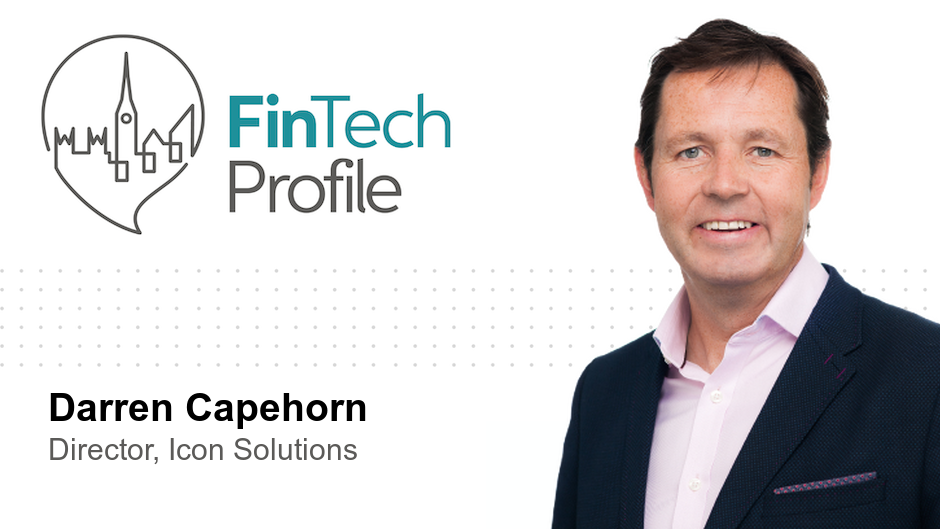
Today we're delighted to speak with Darren, Director at Icon Solutions, a fintech company with more than 17 years' experience in designing and implementing state-of-the-art payments systems. With decades of experience spanning Lloyds Banking Group and the launch of UK Faster Payments, Darren brings a unique perspective on the evolution of payments infrastructure and the transformation challenges facing financial institutions today.
My questions are in bold, over to you Darren:
Who are you and what's your background?
I left Sandhurst Comprehensive School in 1985, having completed my A-levels, with the ambition of becoming a pilot in the Navy. After being accepted as an officer into the Fleet Air Arm, that dream quickly ended when I failed the eyesight test due to astigmatism. I returned home to my parents' house, which happened to be a pub, somewhat rudderless, as I had no plan B.
Fortunately, my mum stepped in. Keen to save both my career, and my liver, she spotted a job advert for a Business Analyst role at Lloyds Bank and submitted an application in my name. Despite her questionable spelling (mine would have been worse) I managed to get the job.
Within two years, I was gathering requirements for a revolutionary customer database, built on what was to become the world's largest online DB2 relational database in production at the time. As the project progressed the lead architect resigned from the bank, and somewhat out of desperation, the programme manager asked me to take over the role.
In 1995 Lloyds and TSB announced their merger, and I was appointed lead architect for payments as we undertook the massive integration of the two banks' systems. This marked my first real foray into the world of payments, and two things suddenly became clear. First, the IT systems underpinning payment processing were among the oldest in the bank. Second, unless they were modernised there would soon be no one left who understood why they did what they did, as the people who had originally built them were approaching retirement.
With that in mind we began a major internal transformation of the Lloyds-TSB payments estate, replacing the existing batch payment system with a platform capable of processing individual payments instantly.
At the time, the UK domestic payment rails (BACS) were still operating on a three-day batch schedule, but it was clear that this model couldn't last forever. In 2004 the industry began defining the replacement for this infrastructure, and I was asked to represent the bank on the industries payments councils, helping shape both the technical and business capabilities of what was to become UK Faster Payments.
It's fair to say that the industry initially underestimated the challenges of instant payments processing. As a result, the programme took longer, and cost more, than most banks expected. At Lloyds-TSB however, we were in a somewhat unique position, having already laid the technical foundations for real-time processing. That gave us a strong perspective on the complexities the wider industry would face on the journey to instant payments.
By 2008, with the launch of UK Faster Payments, I felt it was the right moment to move on from Lloyds-TSB and take the lessons learned to a broader audience, both across the UK and internationally, as other markets, particularly Europe, began their own journey towards instant payments.
What is your job title and what are your general responsibilities?
I used to hold the title of 'Director of Services' but now simply go by 'Director'. Partly this reflects that we now have people on the Leadership team who are far more capable of directing the services we provide. It also reflects the broader scope of my role in the shaping and delivering our product, the Icon Payments Framework (IPF), as well as our services.
Alongside line managing members of the leadership team, I help to guide and evangelise what we build into our product, and how our clients can make best use of it. This aspect of the role draws upon my decades of experience in payments and in delivering technology solutions within large banks.
Having spent 23 years on the buy-side of IT Services and products, I also try to shape a culture that stays true to our 'Complexity Simplified' mantra. One of our biggest differentiators continues to be the trusted relationships we build with our clients.
Can you give us an overview of your business?
Icon Solutions is a fintech company with more than 17 years of experience designing and implementing state-of-the-art payments solutions. Icon was founded on the belief that continuous payments transformation could be made far simpler for financial institutions. Our mission is to help banks modernise their payments systems in a structured, sustainable and scalable way. We enable financial institutions to autonomously transform their payments infrastructure, allowing them to integrate the latest innovations and technologies, while retaining control of their own evolution.
Our core product – the Icon Payments Framework (IPF) – is an internationally proven payments development framework that is trusted by Tier 1 banks across the globe such as Citi, NatWest, UBS and BNP Paribas.
IPF gives banks the technology and processes to independently accelerate the transformation of their payments infrastructure, allowing them to build, test and deploy payments processing solutions much faster, while staying in total control of timelines and costs. When undertaking change becomes quicker and cheaper, clients feel more empowered to step out of their comfort zone and experiment with innovative new payments offerings.
By combining deep industry expertise with advanced technology, we help financial institutions solve today's challenges, while equipping them to lead the future of banking.
Tell us how you are funded?
The initial buy-out from Strategic Thought was self-funded by the three founders.
Investment in our product, IPF, was initially funded through the accrued and ongoing profits from the services side of the business. However, in 2019 a client bank approached us about taking a minority stake in the company, driven by two key motivations: first, to ensure the financial stability of a product that would sit at the core of their payments architecture; and second, to help accelerate the evolution of IPF.
That model has since been repeated, and today three industry clients now hold minority investments in Icon: Citi, NatWest and UBS.
Beyond providing capital to support our growth, all three investors have become valued partners, offering honest advice, guidance and industry insights that help to ensure IPF continues to evolve and stay ahead of the competition.
What's the origin story? Why did you start the company? To solve what problems?
After leaving Lloyds, I joined a small IT company called Strategic Thought. It was full of brilliant individuals, who had previously helped me define and implement change at Lloyds, and together we set about taking our message to a broader market.
However, by 2009 Strategic Thought had decided to focus its sales and marketing efforts on a product it was developing. Owning an IT consultancy had never been on my bingo-card, but in 2009 I joined two colleagues in undertaking a management buy-out of the consultancy arm of Strategic Thought, and Icon Solutions was born.
From the outset, our consultancy approach combined a deep understanding of business needs with technological expertise required to deliver real change. Crucially, we built the company around a simple ethos: our role was to help clients understand payments and IT, not to make things so complex that they became permanently dependent on us. That philosophy helped build strong trust with our clients, and over the next seven years our consultancy business grew 20% year on year.
During that time, while advising a bank that was seeking to refresh its payment technology, we noticed that every solution available to them was still rooted in technology and delivery models from the previous decades. Not only did these solutions fail to embrace modern, more cost-effective technologies and platforms, but they also relied heavily on vendor resources to implement a largely generic product.
As payment consultants, we felt it was our duty to present clients with better alternatives. So, in order to educate ourselves, we embarked on a simple thought experiment, building a demonstration of what a modern payment platform might look like.
When we showed it to our clients, the response was immediate: "When will it be ready for us to buy?"
After much protesting on our part, we finally succumbed and became a Fintech.
Who are your target customers? What's your revenue model?
We are not selling widgets, we are selling payments transformation solutions, with Annual Recurring Revenue (ARR) as the endgame. Our current target customers are large financial institutions embarking on a payments transformation journey.
Our offering is solutions for payments transformation, not services or technology alone. We are uniquely positioned as a one-stop shop with relevant offerings across the transformation journey. This aligns with our DNA and gives us the right to play in this space.
If you had a magic wand, what one thing would you change in the banking and/or FinTech sector?
A more joined-up strategy between IT and Product – a North Star, if you will - would significantly speed up time to market. Whilst lowering costs, this would also reduce the risk of building solutions which put the Bank in a cul-de-sac, such that they must throw away investment in order to achieve the North Star, rather than incrementally advancing towards it.
What is your message for the larger players in the Financial Services marketplace?
When it comes to change, it is essential to execute on your own terms and at your own pace. Limiting dependencies and retaining flexibility to incorporate best-of-breed solutions in your business process is key. Accelerators enable you to stay in control, consolidate capabilities and move forward without slowing down.
Where do you get your Financial Services/FinTech industry news from?
So many sources! But I check LinkedIn and Finextra most frequently.
Can you list 3 people you rate from the FinTech and/or Financial Services sector that we should be following on LinkedIn, and why?
The people in the fintech and financial services sector I always recommend following on LinkedIn are Erin McCune, Chris Skinner, David Birch and Marcel van Oost. I know I am only meant to choose three but there's so many great people working in and promoting our industry, it's hard to decide.
Erin is a really insightful voice on payments infrastructure and the practical realities of money movement. She has lots of hands-on experience in payments and as a result she offers a thoughtful and insightful perspective on how payment systems work and where they're heading.
Chris Skinner is a widely respected commentator on fintech and digital banking. I have enjoyed his books and regularly read his long-running blog, the Finanser, where he explores how emerging technologies, from mobile banking to AI, are reshaping the financial sector and forcing banks to rethink their business models.
David Birch offers fantastic insights into the industry, he is a great futurist and he really helps shape debates on where the industry is heading – he always gives me something to think about especially around issues such as digital currencies and identity in the digital economy.
Like most of the industry, I love Marcel Van Oost too – he makes complex issues so easily accessible to the industry and beyond through unique graphics, charts and visuals. It's great content.
What FinTech services (and/or apps) do you personally use?
Having recently returned from my son's stag weekend, I absolutely love the 'Tricount app'. It's essentially a glorified spreadsheet which enables everyone to keep track of a virtual 'whip' of funds, entering when they spent money and who benefited from the spend.
In truth, the concept is so simple but so useful – allowing the attendees of the stag do to focus on the important part of lining up their favourite Karaoke song!
What's the best new FinTech product or service you've seen recently?
Not necessarily a Fintech product or service, but it's very impressive what tools like Claude are capable of these days. At Icon, we pride ourselves on being early adopters of emerging technologies, carefully assessing innovations and incorporating them into our framework approach when they can deliver real value to our clients.
That same philosophy underpins the way we build and evolve IPF. We deliberately leverage proven, modern technologies such as MongoDB for flexible, high performance data management and Akka for highly scalable, event-driven processing. Together they help us to deliver the resilience, scalability and real-time capability that modern payment architectures demand.
For us, the most exciting developments aren't always single 'products', but the way new technologies can be combined to accelerate innovation and enable financial institutions to transform their payments infrastructure with confidence.
Finally, let's talk predictions. What trends do you think are going to define the next few years in the FinTech sector?
The payments industry is approaching a decisive inflection point. In 2026, three forces, the mass adoption of ISO 20022, the rise of alternative clearing and settlement models, and the rapid expansion of AI beyond traditional use cases, will converge to reshape how payments are processed, managed, and monetised.
These shifts won't just introduce new technology; they will fundamentally change the economics and operating models of banks. Payments consolidation will become a strategic imperative for institutions looking to remain competitive in an increasingly real-time, data-driven landscape.
ISO 20022 reached a major milestone when the MT/MX coexistence period ended, making it the sole messaging standard on SWIFT. While it provides richer, structured data, banks are only beginning to use it strategically for analytics, risk management, and value-added services. Fully realised ISO 20022 implementations, combined with consolidated infrastructure, enable smarter decision-making, better risk management, and more personalised customer experiences.
At the same time, alternative clearing and settlement models are gaining momentum. Digital wallets, cross-border platforms, CBDCs, stablecoins, and tokenised deposits are all challenging traditional RTGS systems. Banks that consolidate their payment flows and embrace flexible, service-aligned infrastructures will be best placed to navigate this fragmentation. Smart routing and unified platforms will allow institutions to manage, qualify, and optimise payments efficiently while providing valuable data insights.
AI is another transformative force. While it has historically been applied to fraud detection and sanctions screening, adoption is accelerating across multiple use cases, from operational optimisation to generative AI-driven interfaces. However, the value of AI depends on high-quality, structured data, ideally across all payment types. Consolidated payment infrastructures provide the foundation to fully leverage AI, enabling banks to turn complex datasets into actionable insights and operational efficiencies.
The strategic imperative for 2026 is clear: banks that consolidate their payment infrastructure, standardise data, and integrate AI will lead the next wave of innovation. Consolidation will be the foundation for speed, security, scalability, and competitiveness. The question isn't whether to consolidate, but how quickly and effectively it can be done: buy, build, or a hybrid approach, but always with control. Your payments, your way.
Many thanks to Darren for taking the time to share his insights with FinTech Profile. You can learn more about Icon Solutions and their Icon Payments Framework on their website.