David Baxter, CEO, Solutions by Text
David Baxter discusses how Solutions by Text is transforming consumer finance with compliance-first messaging and embedded payments through their FinText platform.
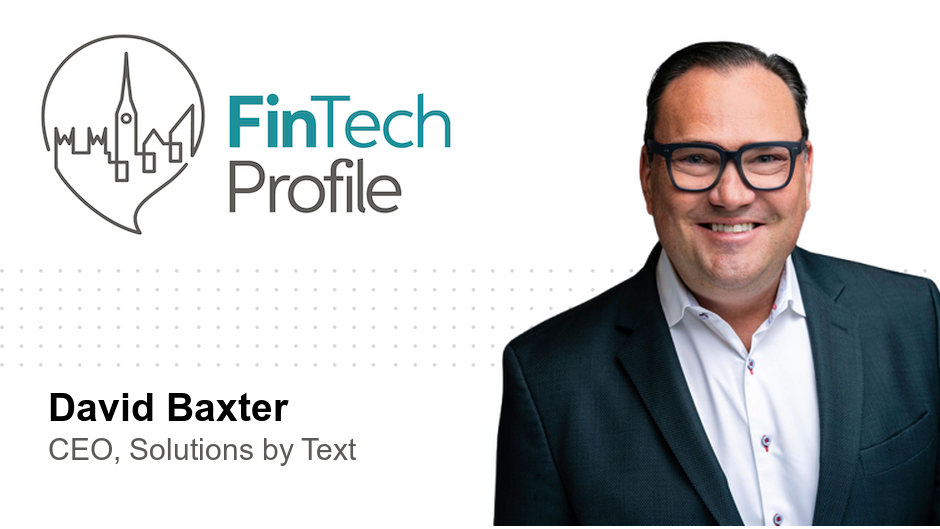
Today we're delighted to speak with David Baxter, Chief Executive Officer of Solutions by Text, the only compliance-first enterprise texting provider helping consumer finance organisations build relationships and integrate payments through their FinText™ platform. With backing from Edison Partners and StepStone Group, David shares how messaging is becoming the new home screen for financial services.
My questions are in bold, over to you David:
Who are you and what's your background?
I'm David Baxter. I've spent my career in financial technology, payments, and consumer finance—specifically in roles where the job is to drive growth whilst navigating complex, regulated environments.
Before joining SBT, I led business development at ACI Worldwide, where I oversaw the largest SaaS sales team for ACI's real-time payments solution for large merchants, financial institutions, and other billers. Earlier in my career, I also held leadership roles at Fidelity National Information Services (FIS), and I started in management roles at AOL and Monster Worldwide; I earned my BA from Manhattan College.
What is your job title and general responsibilities?
I'm the CEO of Solutions by Text and I focus on our strategy and oversee our execution as we grow in the consumer finance ecosystem. I also work to balance our rapid innovation with a deep understanding of compliance—two things many might assume are mutually incompatible. They're not.
We're working to transform the compliant payments experience through our FinText™ platform—making it easier for businesses to have meaningful, measurable customer conversations that can lead directly to action, including payment. I help our team balance that objective by remaining focused on what makes us different: delivering enterprise-grade texting capability built to work in the real world of regulation, consent, and scrutiny.
Can you give us an overview of your business?
SBT enables businesses in consumer finance to engage their customers where they: texting and reading texts. Our compliance-first messaging platform goes beyond talking (alerts, reminders) and integrates useful financial functions, like payments.
Our core notion is that "good conversations pay off," so we've built the platform around enabling real-time conversations and actions that drive tangible, measurable benefits. We're bringing an end to low-yield communication methods like phone calls, mail, emails, and apps. Customers feel overwhelmed and important communication gets lost in the noise. We focus on precision, reach, and results, and we've got outcomes to prove it: 400% ROI and a 97% reduction in time to revenue for customers using SBT.
Tell us how you are funded?
For more than a decade after Danny and Mike Cantrell launched SBT in 2008, our company was truly bootstrapped. Danny and Mike funded growth out of their own pockets, whilst keeping a tight focus on compliance-first messaging. They proved the value of the model in some of the most demanding corners of consumer finance before taking any outside capital. By the time institutional investors came knocking, we already had durable customer relationships, a differentiated compliance platform, and clear product–market fit.
In 2021, we partnered with Edison Partners on a roughly $35 million growth investment, supported by a venture banking facility from Stifel, giving us the fuel to accelerate product innovation whilst executing an aggressive go-to-market strategy and keeping our culture and mission intact. In 2024, we strengthened that strategy with $110 million in new growth financing co-led by Edison Partners and StepStone Group, again alongside Stifel. Today we're scaling our offerings and impact on a strong base of founder ownership, growth equity, and venture debt to extend our FinText platform and help more financial institutions reach customers with compliant, real-time messaging and payments.
What's the origin story? Why did you start the company? To solve what problems?
Danny and Mike Cantrell were prescient. Long before most in U.S. financial services, they saw the potential in texting. Sure, it was how most people actually communicated every day. But they sensed more potential. Banks and lenders still relied on emails, portals, and call centres that consumers were increasingly ignoring.
Their insight was simple but powerful: if you could bring compliant, enterprise-grade SMS into consumer finance, you could radically improve how people receive statements, reminders, and loan updates. They launched SBT in 2008 to do exactly that, building a compliance-first messaging platform that let financial institutions meet customers where they already were: on their phones sending texts.
Those early years were classic founder-journey years. The Cantrells won business one financial client at a time by solving hard compliance and carrier challenges others were afraid to touch. Over time, SBT evolved from simple alerts to rich conversational messaging, and from a consumption-based model into a recurring SaaS platform, always with a focus on regulated use cases like originations, servicing, marketing, and collections in consumer finance. By the time I joined as CEO in 2021, SBT was already sending tens of millions of compliant messages each month and was widely regarded as a trusted specialist in this niche.
I was fortunate enough to build on that foundation. Coming from the world of real-time payments, what excited me was the chance to turn text into a true transaction channel, not just a communication channel. The team had already proven that compliant FinText could transform engagement; the next step was to embed payments directly into those conversations so a consumer could receive a reminder and complete a secure payment with just a few taps or a simple reply. That vision is what led us into embedded payments over text and our FinText strategy. It's why growth partners like Edison Partners and StepStone were eager to back the business: they saw the same incredible opportunity we did to redefine how people pay bills, manage loans, and interact with their financial providers through a single, compliant text thread.
Who are your target customers? What's your revenue model?
We focus on consumer finance. We're built for enterprise use cases where compliance, auditability, and consistency matter—whilst still delivering a simple experience for the end customer.
Our revenue model is built around a recurring SaaS platform. We sell multi-year contracts to banks, lenders, servicers, and collections agencies that rely on us for compliant, enterprise-grade messaging across the full lifecycle—from marketing and originations through servicing and collections—rather than one-off campaigns. That translates into predictable, subscription-like platform revenue, typically scaled by factors such as message volume and use of higher-value capabilities, which is exactly what you would expect from a mature communications and workflow platform in a mission-critical part of our customers' stack.
On top of that core messaging revenue, we're adding significant revenue flow through our FinText Payment Services and embedded "text-to-pay" offerings. This gives us both stability and upside as we drive more value—and more payment volume—through the same compliant text channel.
If you had a magic wand, what one thing would you change in banking and/or FinTech?
Where can I get one? I'd love to see compliance treated like an enabler—a foundation that ensures trust—instead of an impediment to customer experience. Outdated, slow, low-response channels aren't a byproduct of compliance. They are just what they sound like: outdated, and the low response rates reflect consumers voting with their ambivalence. They deserve better.
And better is here: real-time, two-way, compliant conversations. That's exactly what we're enabling.
What is your message for the larger players in Financial Services?
Consumers live in messaging, and anyone who wants better outcomes should meet them there—securely, compliantly, and with a clear path to resolution.
Don't underestimate the operational upside: if you can move from repeated calls and mail cycles to real-time conversations that are measurable, you can dramatically change speed-to-cash and customer satisfaction at the same time. That blend—customer-friendly and operationally effective—is where modern consumer finance needs to go.
Where do you get your Financial Services/FinTech industry news from?
The obvious: WSJ, NYT, Bloomberg, Forbes, Fortune.
FinTech Futures, The Paypers, Finextra, Fintech Magazine, The Fintech Times, PYMNTS, This Week in Fintech, FinTech Global, Fintech Business Weekly, Sifted Fintech (FT-backed).
Three people to follow on LinkedIn (and why)
Ronit Ghose – Global Head of Future of Finance at Citi; offers macro views on digital banking, AI, and CBDCs with strong data and research backing.
Simon Taylor – Co‑founder of 11:FS and voice behind Fintech Brainfood; excellent on embedded finance, BaaS, and product strategy.
Jim Marous – Co‑publisher of The Financial Brand and host of Banking Transformed; a go‑to voice on digital banking, CX, and incumbent transformation.
Theodora Lau – Fintech innovator and author; focuses on financial inclusion, demographics, and the human side of financial innovation.
Alex Johnson – Founder of Fintech Takes; sharp analysis on cards, lending, credit, and fintech–bank partnerships.
Jason Mikula – Publisher of Fintech Business Weekly; deep dives into fintech business models, regulation, and unit economics.
Leda Glyptis – banker‑turned‑fintech exec and author; candid perspectives on change management, legacy tech, and leadership in financial services.
Ghela Boskovich – regtech and policy specialist; strong on data, privacy, and how regulation shapes fintech innovation.
Scarlett Sieber – fintech executive and innovation leader; focuses on how incumbents can adopt startup-style innovation and partnerships.
Marcel van Oost – investor and curator; daily streams of funding news, partnerships, and emerging fintechs across global markets.
What FinTech services (and/or apps) do you personally use?
Revolut, Cash App, Dave.
Best new FinTech product/service you've seen recently
- AI-first finance – Systems act, not just inform
- Invisible Finance – embedded everywhere
- Real-time everything – payments, decisions, credit
Predictions: trends for the next few years
First, the obvious one: Messaging will become the new home screen for financial services. Over the next few years, more customers are going to expect to do real banking work—onboarding, getting help, even making payments—inside a rich text thread instead of bouncing out to a separate app. You're already seeing early data that a big chunk of consumers would rather solve a task in a secure, branded conversation than download yet another app, and as RCS and other rich channels mature, those threads start to look and feel like mini banking apps in their own right, with buttons, forms, and verified branding all in one place. For financial institutions, that means designing customer journeys assuming the conversation is the primary UI, not the afterthought.
Of course, you can't talk trends now without talking AI. AI will move—it's moving today—from back-office insights to radically improving conversations. Think about an intelligent agent that can greet a customer in a verified thread, confirm who they are, answer questions about a loan or card, schedule a payment for Friday, and then seamlessly bring in a human when the situation gets more complex. As rich messaging gets better at verified identity and embedded actions, those AI-powered interactions will feel more natural and trustworthy, and they'll quietly take the friction out of millions of everyday service moments.
All the texting in the world means nothing if consumers don't trust the channel. Trust is foundational, and compliance is the precursor that earns you the right to even be in the conversation. I see trust signals emerging as the new currency for commerce. As more engagement moves into mobile and rich messaging channels, visible trust signals—verified sender badges, secure links, authenticated threads, clear opt-ins—become essential. If a customer can't tell at a glance that a message is truly from their bank or lender and that it's operating inside a compliant framework, they simply won't click, reply, or pay. Firms that bake compliance into the design of every interaction and make that safety obvious to the customer will not only reduce fraud and regulatory risk; they'll see better response rates, higher completion on journeys like bill pay and servicing, and deeper long-term loyalty because customers feel their data, identity, and decisions are being protected.
Finally, the bar on personalisation is going way up—especially for younger consumers who are still sceptical that traditional players really understand them. The institutions that win will be the ones that use behaviour, timing, and identity to deliver messages that feel timely and helpful in the right channel, not just generic blasts that ignore how that customer actually lives and communicates. When a reminder, offer, or alert shows up at the right moment, in the right tone, and in the customer's preferred channel, it stops feeling like marketing and starts feeling like service.
We'd like to thank David for sharing his insights with us today. To learn more about Solutions by Text and their FinText platform, visit their website.