My Advice to Banks on AI: Luke Fenney of LiveRamp
Luke Fenney, SVP at LiveRamp, shares practical advice for bank executives on building AI on governed data foundations, prioritising secure collaboration, and avoiding common strategic mistakes.
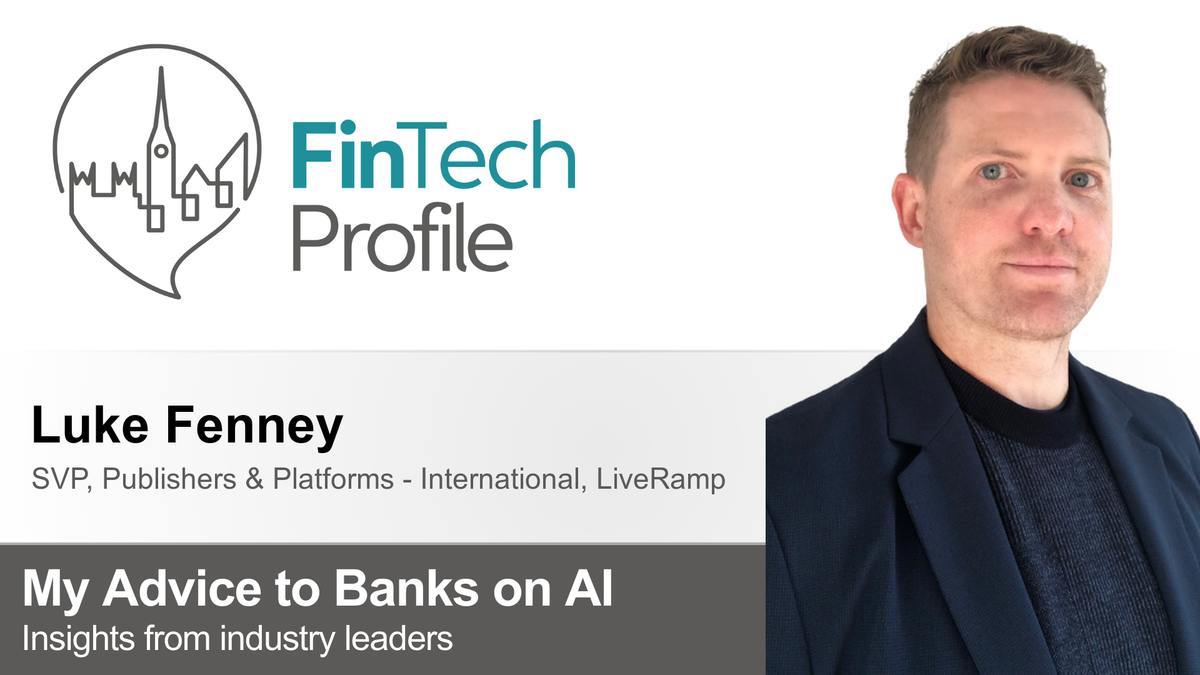
I spoke with Luke Fenney, SVP, Publishers and Platforms for international markets at LiveRamp, based in London. Luke works with leading financial institutions across the UK and Europe, helping them unlock greater value from first-party data, collaborate through privacy-conscious clean room environments, and build the foundations for governed, explainable AI.
Over to you Luke - my questions are in bold:
Can you give us an introduction to you and an overview of your organisation?
I'm Luke Fenney, SVP, Publishers and Platforms for international markets at LiveRamp, based in London.
LiveRamp is the data collaboration network trusted by many of the world's leading brands, retailers and financial services institutions. We provide the platform and connected ecosystem that enables organisations to use data responsibly to deliver more relevant customer experiences, collaborate securely across partners and platforms, and measure outcomes with confidence.
Across the UK and Europe, this increasingly means helping financial institutions unlock greater value from first-party data, collaborate through privacy-conscious clean room environments and build the foundations for AI that is governed, explainable and accountable.
If you were advising a bank CEO today, what would you say is the single biggest mistake they're making with data and AI?
The biggest mistake many organisations are making is treating AI as a series of isolated experiments rather than a capability built on governed, connected first-party data. Banks are running impressive pilots across different parts of the business, but many still sit on fragmented data, inconsistent identity frameworks and limited data governance, making it difficult to scale AI safely and effectively.
In practice, that means AI roadmaps move faster than data and governance roadmaps, when in reality, the opposite should be true. The CEOs who will win are the ones who treat data collaboration, identity, privacy and governance as foundational infrastructure for AI, rather than as compliance hurdles to address later.
What's one AI or data capability banks should prioritise in the next 12–18 months, and why?
If I had to prioritise one capability, it would be establishing a secure data collaboration layer, typically through privacy-preserving environments such as data clean rooms, underpinned by strong identity resolution. This gives banks the ability to securely connect internal data sets with trusted partners and media owners, creating a more connected understanding of their customers while maintaining strong privacy and governance standards.
Getting this foundation right unlocks many of the outcomes banks care most about: delivering more relevant and personalised customer experiences, improving customer acquisition and retention, and gaining a clearer understanding of which marketing and customer interactions are genuinely driving business value.
Where do you see banks overestimating AI, and where are they underestimating it?
Across many industries, not just banking, there can sometimes be a tendency to view AI primarily as a personalisation engine that will automatically overcome fragmented data, legacy systems and siloed operating models. In reality, the effectiveness of AI is still heavily dependent on the quality, connectivity and governance of the underlying data.
At the same time, some of the most transformative AI applications are often found in less visible areas such as data quality, identity resolution, enrichment, measurement and the operational infrastructure that enables secure collaboration across teams and partners. AI applied within a strong governance framework may be less headline-grabbing than consumer-facing chatbots, but it is often where organisations unlock the most durable commercial value and operational efficiency.
What does "good" actually look like when AI and data are working well inside a bank?
"Good" looks like AI becoming embedded into the day-to-day operation of the bank rather than existing as a standalone innovation project.
From a customer perspective, interactions feel more relevant, consistent and timely across every touchpoint. Customers experience the bank as a single organisation rather than a collection of disconnected products or channels, because the underlying data is connected and governed in a secure, privacy-conscious way.
Internally, teams are working from the same trusted data foundation. Marketing, analytics, product, risk and compliance teams can collaborate more effectively because they are aligned around shared customer views, shared metrics and consistent governance standards.
At an executive level, there is clear and measurable evidence that AI is driving value. That might mean improved customer acquisition, higher engagement, lower churn, reduced fraud or better credit outcomes. Crucially, those outcomes are measurable, explainable and auditable.
In that environment, AI stops feeling experimental and instead becomes part of the organisation's operational infrastructure.
What's the hardest AI or data decision bank executives are avoiding right now, and why?
One of the hardest decisions many bank executives are grappling with is moving away from the traditional mindset of keeping data locked within siloed systems, towards a model centred on secure collaboration and responsible data activation. Increasingly, competitive advantage comes not just from owning data, but from the ability to connect and use it effectively across internal teams, trusted partners, platforms and media environments to drive growth.
That requires organisations to think differently about how data is used across marketing, customer engagement, measurement and AI. It means recognising that first-party data is not simply a compliance asset to protect, but a strategic asset that, when governed correctly, can power more relevant customer experiences, stronger acquisition strategies and better commercial outcomes.
Making that shift is not easy. It requires investment in secure data collaboration infrastructure, stronger identity and consent frameworks, and new ways of working across teams and external partners. But it is also becoming one of the defining decisions that will separate organisations able to scale AI and data-driven marketing sustainably from those that continue to operate with fragmented systems and limited visibility into customer and business outcomes.
Thank you Luke! You can connect with Luke on his LinkedIn Profile and find out more about the company at www.liveramp.uk.