Shah Ramezani, CEO & Founder, Noah
Shah Ramezani discusses building payment infrastructure on stablecoins, replacing correspondent banking, and why moving early on digital assets matters for financial services.
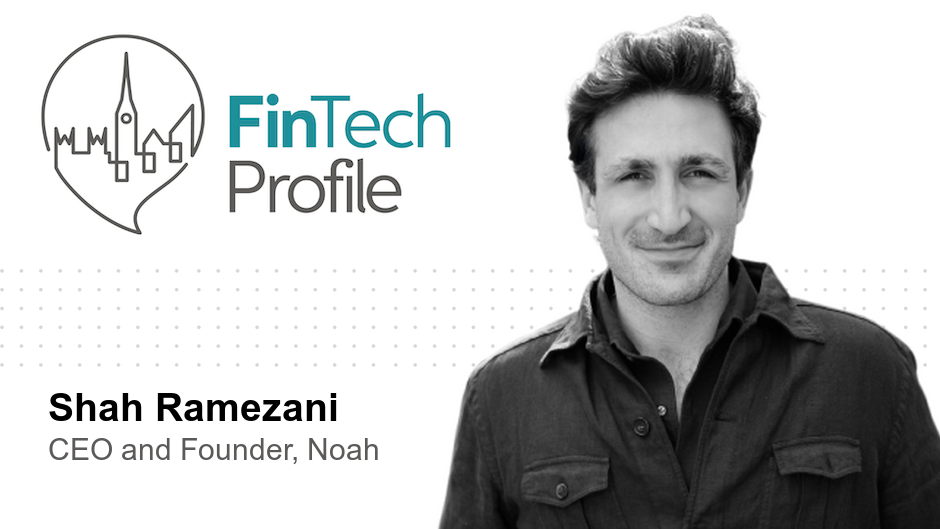
Today we're delighted to speak with Shah Ramezani, CEO and Founder of Noah, a company building payment infrastructure on stablecoins. With cross-border B2B payments on stablecoin rails forecast to reach over $500 billion by 2030, Shah shares why regulated infrastructure is becoming the moat, how his team is replacing correspondent banking chains, and what larger financial services players risk by waiting too long to engage.
My questions are in bold - over to you Shah:
Who are you and what's your background?
I was born and raised in Switzerland and studied business there. Banking and finance were all around me, and I was drawn to it early. I started my career in banking, then did what a lot of people from Switzerland end up doing and moved to London to work at a fast-scaling company.
At some point I wanted to combine the two things I knew best - finance and tech - and think seriously about money itself, how it moves and why. The more closely I looked at it, the stranger it seemed. We've rebuilt almost everything in our lives around speed and the internet. You can send a message across the world in a second. But money still crawls. It moves on rails built for a different era, which are slow, expensive, and walled off by borders. That gap is what pulled me in. I became convinced digital assets could finally change how money moves around the world.
I started Noah and brought Thijn on after being a few years into the company already. He was on the founding team at Adyen and helped grow it from inception, so his experience was exactly what we needed.
What is your job title and what are your general responsibilities?
I'm the CEO and founder. At this stage, my job is mostly the things only the founder can do. I spend a lot of my time focusing on my key stakeholders, fundraising, sales, being close to our largest customers, and on setting the product vision and direction for the business. The rest is hiring the people who will end up doing all of this better than me.
Day to day it swings between the very long term, where is this company going and why, and the very immediate such as a customer call or a deal that needs me in the room. Both matter, and at our stage I can't afford to be good at only one.
Can you give us an overview of your business?
Noah provides payment infrastructure built on stablecoins. We're API-first, so we sit underneath other companies and move money for them.
The simplest way to put it: most cross-border payments still run on correspondent banking, a chain of banks passing money between each other. It's slow, expensive, and opaque, and it hasn't fundamentally changed in decades. We replace that chain with stablecoins as the settlement layer, whilst the customer and their end users only ever touch local currency. Money comes in as fiat, moves as a stablecoin, and lands as fiat on the other side.
There are three core products. Pay-in, where we give businesses virtual bank accounts to collect money in major currencies globally. Payout, where we settle into 70+ countries over local rails, things like PIX in Brazil, UPI in India, mobile money, regular bank transfers - and orchestration, which automates all of it with rules, so payouts can trigger on conditions or thresholds without anyone pushing a button.
What makes us different is that we own the regulated parts. We're licensed globally, and we've spent years building direct local rail coverage. That's the hard, slow work most people avoid, and it's why we can settle money directly in each market. Anyone can talk about stablecoins. Very few people have done the regulatory and infrastructure work that actually makes them useful at scale.
We work with 150+ customers, mostly platforms and marketplaces that move money across many borders and have felt the pain of the old system firsthand. The reaction we hear most is relief that someone is finally building this as proper infrastructure rather than a workaround.
Tell us how you are funded?
We're venture-backed. We've raised around $25M to date from a strong group of investors, including Felix Capital, FJ Labs, and LocalGlobe, alongside angels like Joe Lonsdale. They understood early that this is infrastructure, which means it takes real capital and patience to build the licensed, regulated foundation underneath it. You can't shortcut that part.
I think of our investors as partners, not just investors. People who add real value to the business and who I can call when we need help. So far that's held true with most of our investors, which is the real test of a cap table.
What's the origin story? Why did you start the company? To solve what problems?
The idea didn't come from a whiteboard. It came from watching how badly the current system serves most of the world.
What first pulled me in was a simple observation. Over the last thirty years, the internet reshaped almost everything. The way we communicate, work, shop, build. Technology moved incredibly fast, but money never caught up. It still moves on infrastructure built for a different era. I found that genuinely fascinating, that something so fundamental had been left behind, so I started looking into why.
When I dug in, the strange part was that the technology to fix it already existed. Digital assets and blockchains could move value across the world instantly. But there was a disconnect between that capability and anything a real business could actually use. The raw technology was there but the bridge to the real world wasn't.
You see the gap clearest the moment money has to cross a border, especially into an emerging market. Payments take days. Fees are brutal. Transfers fail with no explanation. A freelancer waits a week to get paid and loses a chunk of it to intermediaries. A business paying suppliers across ten countries needs ten banking relationships and a finance team to babysit them all.
None of this is a technology problem anymore. It's the same shift telecom went through. Once voice moved to the internet, the old per-minute, operator-to-operator model stopped making sense. Money is going through that same change now, except it still travels through correspondent banking, a chain of banks built decades ago that nobody had fundamentally rethought.
That's why we decided to be an infrastructure player. Stablecoins changed the maths, but a stablecoin on its own isn't a product. So, we built the layer in between, regulated infrastructure that uses stablecoins underneath and abstracts all the complexity away. Our clients get the speed and cost benefits without ever having to think about the wallets, the conversions, or any of the moving parts beneath them. It just feels like normal money.
We're deliberate about where we point this. We do it at a global scale, but only where stablecoins actually matter most, which is cross-border payments. We don't dabble into other use cases that you could bolt on. We've stayed focused on what we think is the killer app and gone deep on it rather than wide. That focus is the whole point.
That's the problem we exist to solve - to make moving money across borders as fast and cheap as sending information, for the parts of the world that have been waiting longest for it.
Who are your target customers? What's your revenue model?
Our customers are businesses that move money across borders at scale. We started with the hardest segment to serve - neobanks - the consumer-facing financial apps that force you to handle every edge case across every currency, country, and rail. If you can serve them, you can serve almost anyone. Jupiter, Ledger, KAST, Lemon and others run on our infrastructure.
That was the proof. The prize is everything adjacent to it. Global enterprises like Opera. Payroll and marketplace platforms like Deel, where the volumes are far larger and the complexity is actually lower. And further out, agentic payments, where AI agents will need to move money too. It's one stack across all of it.
Consequently, we've recently shifted to an enterprise-first motion, which was a deliberate move up-market towards larger, stickier contracts.
On the model, it's usage based. We make money on the volume that flows through our infrastructure. The more our customers move and save, the more we earn, which means our incentives are aligned with theirs. We grow when they grow. And because we own the licensing and the local settlement rather than renting it, more of the economics stays with us instead of being passed through to middlemen.
If you had a magic wand, what one thing would you change in the banking and/or FinTech sector?
Right now, your financial life is mostly an accident of geography. If you're in the right country, money is fast, cheap, and works. If you're not, you pay more, wait longer, and get cut off from the global economy for reasons that have nothing to do with you. A business in an emerging market pays a tax on every cross-border transaction simply for being there. That isn't a law of nature. It's a leftover from infrastructure, built decades ago that nobody rebuilt.
If I had one wave of the wand, money would move across the world as freely as information does. Same speed, same cost, whether you're in London or Lagos. That single change would do more for people in emerging markets than most development programmes because it lets them participate in the global economy on equal terms instead of from behind a toll booth.
What is your message for the larger players in the Financial Services marketplace?
Don't underestimate the speed of this one.
Financial services have a long history of underestimating technological change. The pattern is always the same. A new technology looks small and easy to dismiss, so the incumbents wait. By the time it obviously matters, the window to act on your own terms has already closed, and you're reacting instead of leading. It happened with the internet, with mobile, and with cloud. Stablecoins are next, and they're compounding faster than any of them.
The numbers are already hard to ignore. Citi projects the stablecoin market will reach somewhere between $1.9 and $4 trillion by 2030, up from under $300 billion today. Cross-border B2B on stablecoin rails is forecast to go from around $13 billion this year to over $500 billion by 2030. That's not a fringe experiment; it's a rail being built underneath the financial system.
So, my message is simple. Engage now, whilst you can still shape your position, rather than later when you're forced into it. The cost of moving early is a bit of discomfort. The cost of moving late is irrelevance.
Where do you get your Financial Services/FinTech industry news from?
Mostly from X and LinkedIn. There are also emails I'm subscribed to that I keep reading.
Can you list 3 people you rate from the FinTech and/or Financial Services sector that we should be following on LinkedIn, and why?
What FinTech services (and/or apps) do you personally use?
Revolut mostly
What's the best new FinTech product or service you've seen recently?
Revolut, by far the best product in the world.
Finally, let's talk predictions. What trends do you think are going to define the next few years in the FinTech sector?
Stablecoins will stop being a digital assets story and become plumbing. In a few years, most people using them won't even know they are. They'll just notice their money moves faster and costs less.
Money starts to behave like information. Sending value across a border becomes as instant and cheap as sending a message, and once that's normal, correspondent banking and multi-day settlements start to look like the fax machine.
The winners will be the ones who did the unglamorous, regulated work. Regulation becomes the moat, not the obstacle. And further out, payments stop being purely human. Software and AI agents will transact on their own, moving money without a person clicking a button. That's closer than most people think, and it needs rails built for it.
Thank you to Shah for taking the time to share his insights with us. You can learn more about Noah at noah.com, and connect with Shah on LinkedIn.