Adam Famularo, CEO, WorkFusion, a UiPath company
Adam Famularo discusses how AI Agents are transforming financial crime compliance and why banks need to move now to stay competitive.
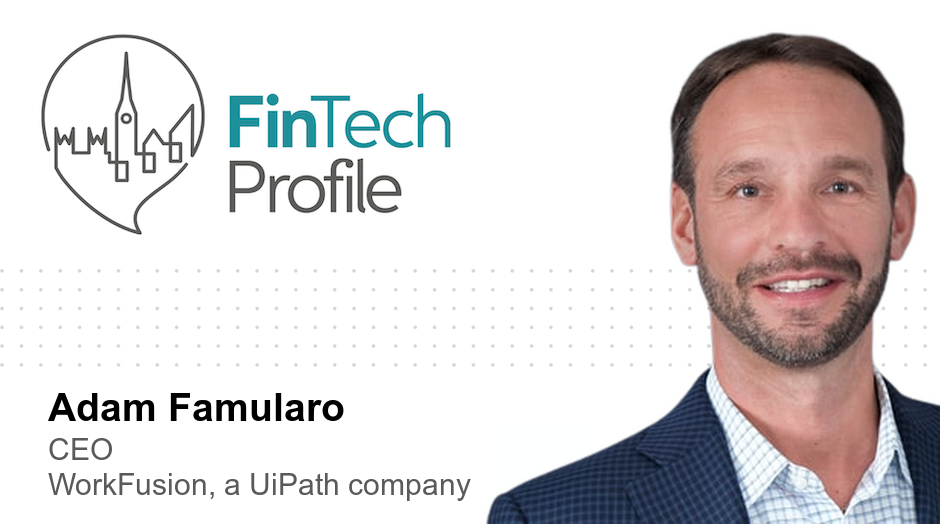
Today we're delighted to speak with Adam, CEO of WorkFusion, a UiPath company, the leading provider of AI Agents for financial crime compliance. Following WorkFusion's recent acquisition by UiPath in February 2026, Adam shares his insights on how AI is fundamentally reshaping how banks combat financial crime, why the window for early advantage is closing, and what lessons he's learnt from customers who treat their AI automations like members of the team.
My questions are in bold - over to you Adam:
Who are you and what's your background?
I've spent my entire career at the intersection of technology, innovation, and operational transformation. Early in my career at CA Technologies, I learned how to be an entrepreneur inside a large company — how to build teams, scale products, and stay relentlessly customer‑centric. Later, at erwin, a company that I co-founded, I helped take proven technology and build an entirely new market around data governance, which taught me how to turn customer insight into product strategy.
When I joined WorkFusion, I realised we needed to productise the software. I did a deep dive with every customer to understand the real value they were getting from the product. First, what I discovered was that our best use cases centralised around financial crime compliance. Second, our most successful customers were treating our software like members of their team — giving the automations human names, assigning them roles, even creating cardboard cutouts. That insight became the foundation for our AI Agents focussed on automating financial crime compliance work model.
That customer‑driven insight, combined with my background in enterprise software and regulated industries, is what ultimately led me deeper into the FinTech and financial crime compliance space.
What is your job title and what are your general responsibilities?
As CEO, I'm responsible for setting the vision, driving the strategy, and ensuring we deliver measurable value to our customers. Day to day, that means staying close to our product roadmap, our customers' needs, and the rapid pace of AI innovation. I spend a lot of time with banks, regulators, and partners to understand where the industry is heading and how our AI Agents can help institutions stay ahead. I also focus heavily on culture — building teams that move fast, innovate boldly, and stay grounded in the mission of fighting financial crime.
Can you give us an overview of your business?
We build AI Agents that transform financial crime compliance operations. Our Agents automate the bulk of L1 and L2 analyst and investigative work — sanctions screening alert review, KYC, adverse media monitoring, transaction monitoring alert review/investigations, enhanced due diligence and fraud investigations — and they do it with transparency, evidence, and audit‑ready decisioning.
We're unique because our Agents aren't generic LLMs. They're trained on years of real FCC investigations, built specifically for regulated environments, and designed to produce consistent, defensible decisions at scale.
Tell us how you are funded?
WorkFusion was venture‑funded through its growth stage and is now a subsidiary of UiPath following our acquisition in February 2026. The acquisition gives us the stability and scale to accelerate our roadmap whilst maintaining deep focus on financial crime compliance.
What's the origin story? Why did you start the company? To solve what problems?
WorkFusion's roots go back to MIT, where the original technology was designed to combine AI with complex document and decision workflows. When I joined the company, I spent months meeting with customers to understand where that technology delivered the most value. That roadshow made the opportunity unmistakably clear: financial crime teams were overwhelmed. Banks were facing soaring alert volumes, staffing shortages, and regulatory pressure that their existing tools simply couldn't keep up with.
The real breakthrough came when I noticed how customers were using our early automation. They weren't treating it like software — they were treating it like a teammate. Some even gave it human names or created cardboard cutouts. That told us something important: banks didn't need another platform. They needed AI Digital Workers who arrived trained, ready, and capable of doing the work alongside human investigators.
From there, the mission became obvious. We focussed the company on building purpose‑built AI Agents for financial crime compliance — areas where the work is high‑volume, high‑stakes, and deeply dependent on consistency and evidence. Our goal was to help banks scale expertise, improve quality, and free investigators to focus on the decisions that truly require human judgement. Today, our AI Agents review millions of sanctions screening and adverse media alert hits per day, freeing up the capacity of thousands of Level 1 analysts, or the equivalent of tens of thousands of hours for its customers per day.
That combination of breakthrough technology and a very real customer problem is what shaped us into what we are today.
Who are your target customers? What's your revenue model?
Our customers are banks and financial institutions of all sizes — from top‑10 global banks to regional and digital‑first institutions. They all face the same challenge: rising alert volumes, rising costs, and rising regulatory expectations.
Our revenue model is subscription‑based and tied to the work our AI Agents perform.
If you had a magic wand, what one thing would you change in the banking and/or FinTech sector?
I'd accelerate adoption. The industry is still too risk‑averse, and the speed of adoption doesn't match the speed of innovation. Banks that move faster will win. Those that wait will lose ground quickly.
What is your message for the larger players in the Financial Services marketplace?
My message is simple: move now. The institutions that act quickly on AI will widen their competitive advantage, and the ones that wait will spend years trying to catch up. Every major bank is feeling the pressure — rising alert volumes, staffing shortages, and regulatory expectations that aren't slowing down. AI Agents are the fastest, safest way to add capacity, improve quality, and strengthen controls.
This isn't experimental anymore. Regulators have seen these systems. Top‑tier banks are already running them in production. The risk profile is low, the value is immediate, and the window for early advantage is closing. If you're a large institution, this is the moment to lean in.
Where do you get your Financial Services/FinTech industry news from?
Financial Times, WSJ, BankDirector.com
Can you list 3 people you rate from the FinTech and/or Financial Services sector that we should be following on LinkedIn, and why?
- Colin Smith is one of the most forward‑thinking leaders in financial crime operations today. He has a rare ability to connect strategy, technology, and day‑to‑day operational realities — and he's been a champion for modernising FCC through AI and intelligent automation. His perspective on how large institutions adopt and scale new technology is invaluable.
- Julie O'Connor is a true innovator in leveraging technology to transform financial crime compliance operations. She brings a deep understanding of both regulatory expectations and the practical challenges analysts face every day. Her insights on how AI and automation can elevate quality, consistency, and efficiency make her a must‑follow voice in the space.
- Jacqueline Santos is a pioneer in AML and sanctions, with a career that spans frontline operations, risk management, and technology‑enabled transformation. She has a clear, grounded view of how financial institutions can modernise their approach to risk whilst staying aligned with regulatory expectations. Her commentary is consistently sharp, practical, and ahead of the curve.
What FinTech services (and/or apps) do you personally use?
I tend to gravitate towards FinTech products that make everyday financial tasks feel simple, transparent, and secure. I use Stripe for its clean, developer‑first approach to payments — it remains the benchmark for frictionless money movement. And with teens in high school and college, Venmo has become a staple in our household; it's the easiest way to handle everything from shared expenses to last‑minute "Mum, Dad, can you send…?" requests. For day‑to‑day banking, I appreciate how SoFi has pushed the industry towards faster, more intuitive digital experiences. These products remind me how much room there still is for innovation in mainstream financial services.
What's the best new FinTech product or service you've seen recently?
One of the most compelling innovations I've seen recently is WorkFusion's own AI Transaction Monitoring Investigator, Isaac. I know it sounds self‑referential, but Isaac represents a genuine step change in how financial institutions approach both transaction monitoring investigations. Instead of simply accelerating existing workflows, Isaac actually performs the first level of investigative work — reviewing alerts, gathering evidence, drafting narratives, and escalating only the cases that truly require human judgement. It's the first time banks can deploy an AI Agent that behaves like a trained analyst, not just an automation tool.
What excites me most is how quickly institutions are seeing impact: faster investigations, more consistent decisions, and a meaningful reduction in false positives. In a world where fraud and financial crime are evolving faster than traditional systems can keep up, Isaac gives banks a way to modernise their defences without ripping out their core infrastructure.
To me, that's the kind of FinTech innovation that matters — technology that strengthens trust, improves resilience, and helps financial institutions operate with more intelligence and confidence.
Finally, let's talk predictions. What trends do you think are going to define the next few years in the FinTech sector?
AI is going to define the next era of financial services — not as a buzzword, but as the new operating model for how institutions run. Every major function inside a bank is being reshaped by intelligent automation: from new account opening to customer marketing to risk management. And in financial crime compliance specifically, we're already seeing the shift from traditional workflows to AI Agents like our Isaac, which can actually perform investigative work in transaction monitoring and fraud. That's a fundamental change in how banks manage risk.
The institutions that lead will be the ones that embrace AI not as a tool, but as a core capability — a way to operate smarter, faster, and with far more resilience than the legacy models allow.
Many thanks to Adam for taking the time to share his insights with us.
To learn more about how AI Agents are transforming financial crime compliance, visit WorkFusion.