My Advice to Banks on AI: Radomir Mastalerz of WealthArc
WealthArc's CTO warns banks against starting with AI tools before building solid data foundations, and explains why a unified data layer should be the priority.
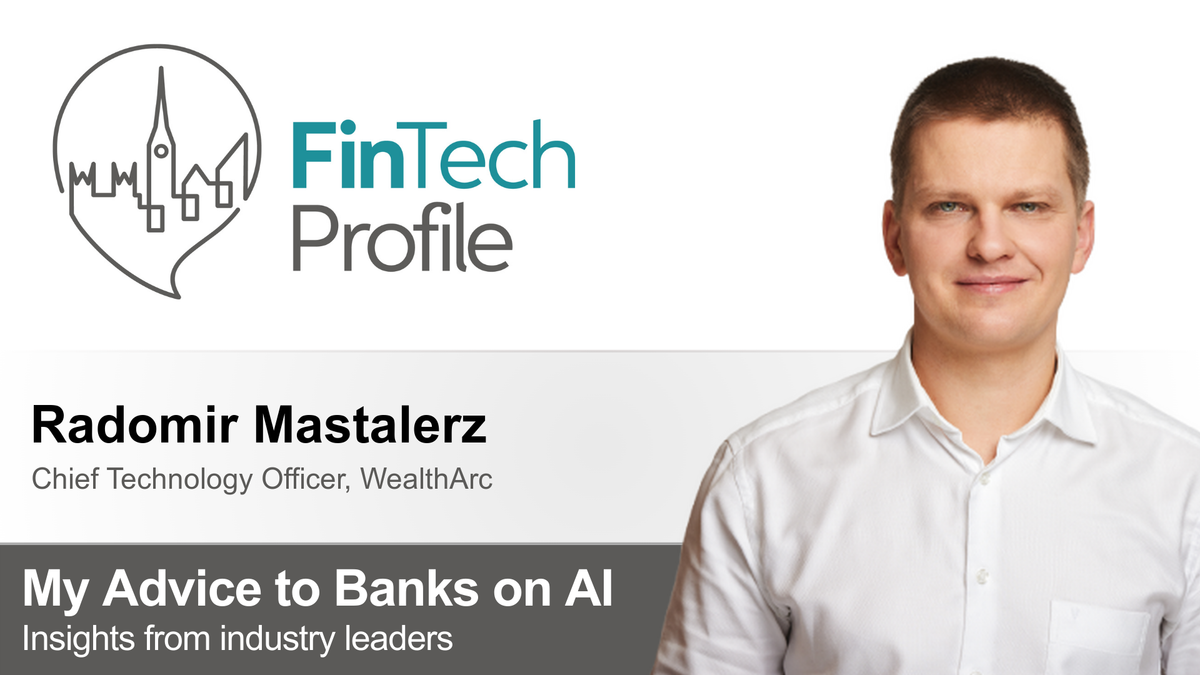
I spoke with Radomir Mastalerz, co-founder and CTO of WealthArc, about the practical challenges banks face when deploying AI. With a background spanning software engineering, financial mathematics, and building systems for institutions like UBS and Deloitte, Radomir offers clear-eyed advice on why data infrastructure matters more than shiny AI pilots.
Over to you Radomir - my questions are in bold:
Can you give us an introduction to you and an overview of your organisation?
I'm the co-founder and CTO of WealthArc. I lead product, technology, and operations. My background is in software engineering and financial mathematics, and I've spent most of my career building systems for financial institutions, from credit risk platforms at UBS to enterprise risk management software at Deloitte.
We founded WealthArc in 2015 because we saw a structural problem in wealth management. Firms were investing in portfolio systems, analytics tools, and client portals, but the underlying data remained fragmented. Custodian feeds, Excel files, CRM exports, and reporting tools all held slightly different versions of the same portfolio. That fragmentation limited automation and made scaling difficult.
Today, WealthArc provides a global data infrastructure layer for wealth managers, multi-family offices and wealthtech providers. Through our WealthArc Data Box platform, which aggregates and reconciles portfolio data from more than 160 custodians and financial sources, standardise it across currencies and asset classes, and make it reusable across reporting, analytics, client servicing and AI-driven workflows.
Our core belief is that data should not be trapped inside applications. It should be governed, controlled, and reusable across the organisation. When that foundation is strong, everything else becomes easier.
If you were advising a bank CEO today, what would you say is the single biggest mistake they're making with data and AI?
The biggest mistake I see is starting with AI tools instead of starting with data foundations. AI gets treated as a starting point rather than as an outcome of good data architecture.
AI is a powerful tool taking as an input curated input data and prompts with instructions, and delivering a desired output. The output is as good as the input data and instructions provided to AI. Many institutions are experimenting with AI pilots, and they soon realise their data infrastructure is fragmented and unprepared - data is stored in various systems in multiple versions, it is incompatible and lacks a clear semantic definition. Keeping the data consistent and synchronised between systems often requires manual workflows. We see it especially with client data and investment data, requiring manual reconciliation in the background. AI does not solve those problems; in fact, it magnifies them.
If the underlying data is inconsistent or poorly governed, AI models will produce outputs that look sophisticated but are difficult to trust. That erodes confidence quickly, both internally and with clients.
Before asking "Which AI use cases should we deploy?", bank leaders should ask a more basic question like "Do we have a single, reliable, auditable source of truth for our portfolio and client data?" Without that, AI adoption will remain superficial.
What's one AI or data capability banks should prioritise in the next 12–18 months, and why?
If I had to choose one capability, it would be building a unified, reconciled data layer that sits independently from front-end applications. That may not sound as exciting as deploying new AI interfaces, but it is foundational and transformative. Many banks still rely on application-specific data silos. Portfolio systems maintain their own datasets. Reporting tools have their own interpretations. CRM systems hold separate client views. This makes automation fragile and slows down decision-making.
A central data layer (one that consolidates multi-source data, enforces validation rules, and makes structured information reusable across workflows) creates long term flexibility. Once that exists, AI initiatives can build on top of it reliably.
In practical terms, that means investing in reconciliation, data lineage, and governance before investing heavily in AI interfaces. It also reduces vendor lock-in and makes future system changes less painful.
If institutions get this right, they'll be able to adopt AI faster and surely with more confidence.
Where do you see banks overestimating AI, and where are they underestimating it?
Banks often overestimate AI's ability to fix structural inefficiencies without deeper operational change. AI can enhance workflows, but it cannot compensate for fragmented processes or inconsistent data architecture. There is sometimes an assumption that adding an AI layer will "modernise" the organisation. In reality, AI is highly dependent on the quality and structure of the data environment it operates within. At the same time, banks often underestimate the impact of AI on operational workflows. AI is already capable of accelerating document processing, reconciliation checks, onboarding procedures, and monitoring tasks. These are not theoretical use cases, they are practical, high-volume activities where productivity gains are tangible. The real shift is not AI replacing humans, it's AI reducing the manual handling of information so that teams can focus on making higher-value decisions.
What does "good" actually look like when AI and data are working well inside a bank?
When AI and data are working well, the impact is visible in everyday operations rather than in presentations. Which means data is consistent across systems, teams are not debating which number is correct, portfolio views reconcile cleanly across custodians, and reporting does not require manual adjustments at the last minute.
AI tools operate within clear boundaries, with strong governance and human oversight, outputs are explainable and traceable, risk teams understand how models are fed and monitored. Most importantly, confidence improves. Advisors and relationship managers can rely on the data in front of them. Operational teams spend less time correcting errors, and the management has clearer visibility into performance and exposure.
Overall, AI implementation is not about impressive dashboards. It's about stable, reliable processes working in the background.
What's the hardest AI or data decision bank executives are avoiding right now, and why?
The hardest decision is committing to structural change. Many institutions know their data environment is fragmented. They know legacy systems create duplication and manual work. But untangling those systems is complex, sensitive, and resource-intensive. It is easier to layer new tools on top of old infrastructure than to rebuild foundations.
However, that approach increases long-term complexity. The difficult conversation is about separating data from applications, redesigning core processes, and investing in governance that may not necessarily produce visible results but creates long-term resilience. That decision requires patience and alignment across business, technology and compliance functions. It's not a quick win, but without it, AI adoption will remain constrained.
Thank you Radomir! You can connect with Radomir on his LinkedIn Profile and find out more about the company at wealtharc.com.