My Advice to Banks on AI: Scott Zoldi of FICO
FICO's Chief Analytics Officer shares why banks must prioritise AI development standards and blockchain-based auditability to avoid reputational damage.
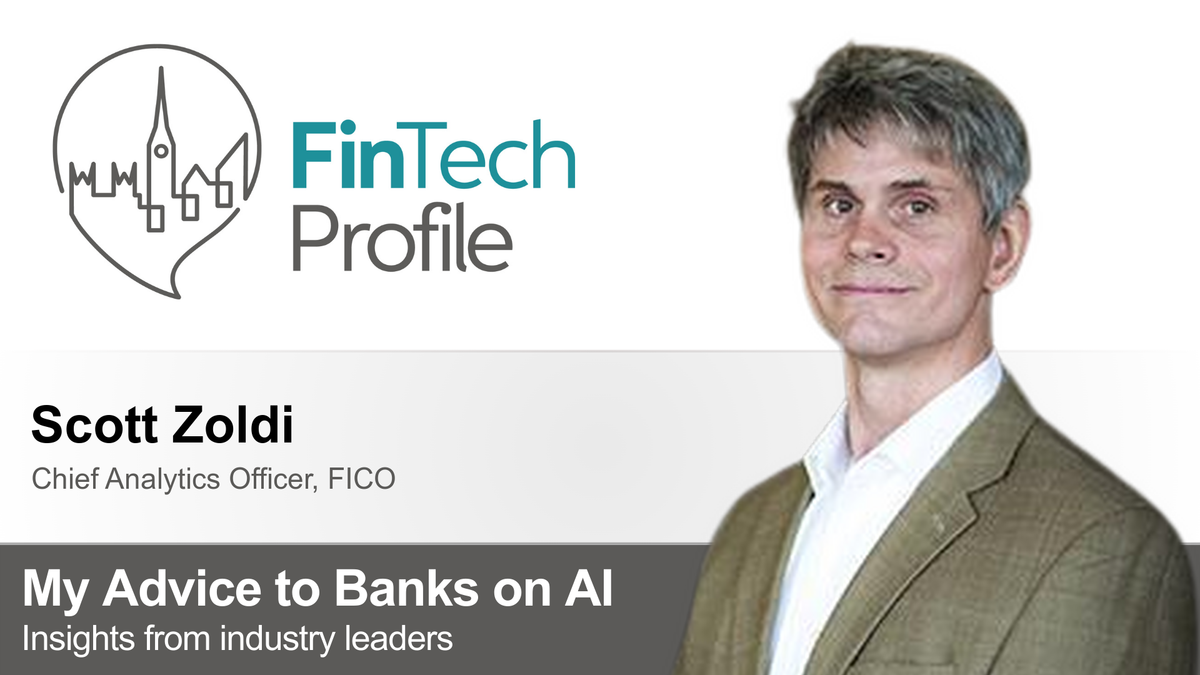
I spoke with Scott Zoldi, Chief Analytics Officer at FICO, who brings a unique perspective to AI strategy—from theoretical physics to pioneering neural networks for fraud detection, and now leading responsible AI innovation for banks globally. With 122 patents to his name and a team of over 100 research data scientists, Scott shares practical advice for bank executives navigating AI deployment, model governance, and the gap between AI hype and sustainable business value.
Over to you Scott - my questions are in bold:
Can you give us an introduction to you and an overview of your organisation?
The short story is, I am a scientist who "took the red pill" and landed in the business world.
The longer story is, after I earned my Ph.D. degree in Computational and Theoretical Physics, I was awarded a Director's Postgraduate Fellowship at Los Alamos National Labs. While it was a privilege to walk in Oppenheimer's footsteps, I chose to join HNC Software, a San Diego company that pioneered the use of neural networks for fraud detection, to protect people from financial crime.
FICO acquired HNC Software in 2002, and I have been with FICO ever since, developing specialised AI and analytic decisioning engines to detect fraud and scams, manage risk and ensure the regulatory compliance of AI use.
I became FICO's Chief Analytics Officer in 2015 to drive business value for our customers, which include leading financial institutions and fintechs globally, by providing real-world AI innovation. I've been granted 122 AI and software patents, most recently for Responsible AI innovations that make AI and GenAI safe and reliable for banking and other highly regulated industries. These include using blockchain technology to create immutable records of AI model development and monitoring, and the invention of focused language models––smaller, faster, and far more effective type of GenAI for high-value financial applications in which AI must be applied responsibly.
I am proud to lead a team of more than 100 research data scientists located in San Diego, Bangalore, India, and Guadalajara, Mexico. We are incessantly working through the hard details necessary to take ideas from academic discourse to reality and responsibly operationalise innovation for demonstrable business benefit and positive customer impact.
FICO's data science team is intensely focused on solving customer real-life problems like payment fraud, how to deploy AI responsibly, and how to expand use of real-time transaction analytics. We're constantly looking at business problems that don't have a solution or need a better one.
If you were advising a bank CAO today, what would you say it the single biggest mistake they're making with data and AI?
Too many financial institutions are deploying AI without understanding how it works or the downstream implications of doing so. The resulting problems snowball into damage that is both financial and reputational and can occur very quickly.
The kernel of any AI deployment is the AI model, and the data and processes that went into training the model. Many banks don't have a single AI model development standard or a means to enforce that standard, including a detailed enough provenance on the training data, or AI development steps to meet auditable AI standards. They need to get there.
Committing the entire development process to a private blockchain provides an immutable trail of decision-making for every model. The blockchain eliminates any confusion about requirements, algorithms used, training data used, and success criteria to be met; all of these components are committed to the blockchain before development starts. The blockchain also permanently links to assets that demonstrate adherence to standards, exposes latent features in the model, determines if they introduce bias into the model's decisioning, and includes specific AI model monitoring procedures, which are lacking in banks' use of AI today.
Without an immutable blockchain record, when AI runs amok, finger-pointing ensues. The blockchain produces not just a checklist of positive outcomes; it also includes mistakes, corrections, and improvements made along the way. We can see who worked on the latent features, which tests are done, the approving manager, and management sign-off. Further, when the model is successfully built and in production, it provides assurances when and for how long the AI model should be used.
What's one AI or data capability banks should prioritise in the next 12–18 months, and why?
First, it's getting to a single AI development standard for the entire corporation. As a very close second, banks should prioritise implementing blockchain to enforce the AI development standard. This approach affords not just a 360-degree view in the rear-view mirror; banks can then utilise blockchain to gain auditability of the AI development, and a guide on how to monitor the performance of the AI. Model drift and bias can creep quickly, and banks are not systematically monitoring AI models appropriately today––with particularly devastating impacts.
Last year, a study by Corinium Global Intelligence found that less than 10% of banks have adequate AI monitoring capabilities, and that is alarming.
Where do you see banks overestimating AI, and where are they underestimating it?
In terms of overestimating, banks are constantly hearing about how AI will put them out of business if they are not applying this unknown and unpredictable technology at haste, because their competitors already are. The reality is, implementing AI correctly and compliantly is hard, particularly when banks jump into agentic AI applications without understanding their implications. Getting sustained, real business value from AI is even harder.
Banks may have gung-ho enthusiasm about deploying the frontier large language models they read about in the news every day, but where they are underestimating AI is in the power of small, focused language models. We are seeing huge uptake of small, domain-specific, task-based models globally, which today can easily outperform the largest LLMs at a fraction of the cost.
What does "good" actually look like when AI and data are working well inside a bank?
"Good" AI is built to an AI corporate development standard that includes auditability and proper monitoring. It also includes controls to understand when not to trust the AI model, a concept called "humble AI."
Once a development infrastructure is in place, the bank has full control and confidence that their models are appropriate, are monitored, and they have a fallback strategy planned. Success is codified in how to operationalise the AI, and what happens in different business situations. This is how banks actually achieve sustained AI value.
"Good" AI is also defined by what doesn't happen. There are no sleepless nights or prolonged debates on whether an AI model is "ready for prime time." Models are not held back from production because of uncertainty about their risk, or lack of artifacts demonstrating adherence to the company's development standards.
With "good" AI, scientists don't inadvertently tap production models for research projects or, worse, release data science experiments "into the wild." Time isn't wasted in rejecting work if a data scientist veers acceptable practices, intentionally or not; the blockchain keeps teams cohesive, on-standard and meeting requirements, efficiently producing models that meet quality and safety standards.
What's the hardest AI or data decision bank executives are avoiding right now, and why?
Everyone wants to do what the "cool kids" are doing, even banks. The hardest decision for banks right now is whether, and when, to jump into agentic AI. It's the latest big trend, holding significant promise. But agentic AI is only at an early maturity level.
In this moment, most banks are still struggling to achieve reliable, repeatable results, and sustained value with GenAI, while finding their way to the "safe zone" of domain-specific task models. Having to justify why they are not jumping on the next AI trend can be hard.
In the end, though, the way to respond to "FOMO" in their organisation is to focus on the specific business value that any given AI deployment needs to address, and how to achieve it responsibly, safely, and confidently. This is not about showing usage of any specific AI fad but focusing on the business value to be delivered and the most appropriate analytic or AI approach. This is where AI becomes indispensable.
Thank you Scott! You can connect with Scott on his LinkedIn Profile and find out more about the company at fico.com.